Agriculture and food
Autonomous tractors, precision planting, robotic harvesting, soil monitoring, irrigation and greenhouse systems could increase output while reducing repetitive labour and waste.
 WORLD SOVEREIGNTY FUND& THE BIRTHRIGHT SYSTEM
The future of community-owned prosperity
What if machines could take on more of society's work—and the wealth they create could help secure every person's future?
A short conceptual video accompanying the staged vision. The existing longer entrance video remains unchanged.
01 / A new economic possibility
Machines already perform tasks in factories, farms, warehouses and software systems. Future advances could make them capable of far more. The World Sovereignty Fund proposes a way for communities to own and operate some of that productive capacity—so the economic benefits are not limited to private machine owners.
02 / Where machines could help
These are examples of existing applications and potential future capabilities. The extent of full autonomy varies greatly by sector, and humans remain essential to many tasks today.
Autonomous tractors, precision planting, robotic harvesting, soil monitoring, irrigation and greenhouse systems could increase output while reducing repetitive labour and waste.
Robotic assembly, inspection, fabrication and predictive maintenance could help produce everyday goods more efficiently, with human technicians supervising complex operations.
Automated warehouses, delivery robots and eventually more autonomous trucks and buses could move people and goods, subject to safety, infrastructure and regulatory requirements.
Robotic fabrication, modular construction, site surveying and building maintenance could help lower some costs and increase construction capacity. Land, permits and materials would still matter.
Assistive robots, diagnostics support, medication logistics and mobility technology could reduce strain on caregivers while keeping clinical judgment, consent and human connection central.
Automated grid monitoring, renewable-energy maintenance, water treatment and infrastructure inspection could improve reliability and reduce hazardous tasks.
Robotic recycling, reforestation, pollution detection and ecosystem monitoring could support conservation when projects are designed with ecological safeguards.
AI tutoring tools, accessible translation and administrative automation could make services easier to deliver, with educators and accountable public institutions retaining oversight.
03 / The community owns the brain
In the proposal, a community-owned Omni-Superintelligence Centre would coordinate and maintain fleets of robots, autonomous vehicles, farm equipment and other automated systems. The centre could rent equipment and services to local businesses, farmers and public agencies, and pay people who provide oversight, repairs and other services.
“Omni-Superintelligence Centre” is the proposal's name for a future coordinating institution. It is not a claim that superintelligent AI systems currently exist or that one centre can safely control every machine without human oversight.
04 / The economic engine
Invests and safeguards long-term capital. Under the proposal, distributable earnings could be allocated 70% to people, 20% to communities and 10% to ecological priorities. The Fund itself is not a bank.
A proposed separate financial service supporting automation-related payments and operations. Existing banks and private enterprise would remain, and could also participate voluntarily.
Illustrative mechanism only: gross revenue is not profit. Contributions would depend on actual contracts, ownership, operating costs, taxes, reserves, governance and financial sustainability. No dividends or income floor are currently guaranteed.
05 / The employment transition
More demand for engineers, technicians, electricians, construction workers, operators, trainers, safety experts and infrastructure specialists. Some routine tasks are displaced even at this stage.
Robots and AI increasingly take over repetitive, hazardous and predictable work. New roles emerge, but many existing roles shrink or change. Education and transition support become essential.
If productivity, public ownership and investment income grow enough, a funded income floor could reduce the need to work merely to survive. Total elimination of jobs is not assured or necessary.
06 / What shared prosperity could mean
Income security and investment in affordable housing could help prevent homelessness, provided construction, land use and local services expand too.
Automation could help with mobility, food, maintenance and everyday support as people age, while human caregivers remain indispensable.
A dedicated allocation could support cleaner energy, restoration and resource efficiency, with careful accounting for the environmental footprint of robotics and computing.
07 / A future worth building
The proposed system would grow alongside existing banks, businesses and currencies. It would need public consent, enforceable safeguards, independent audits and decades of responsible development. Its promise is a new way to share some of the value that automation creates.
The progression below illustrates one possible community-first path. The timeframes are planning scenarios, not reliable forecasts of global adoption.
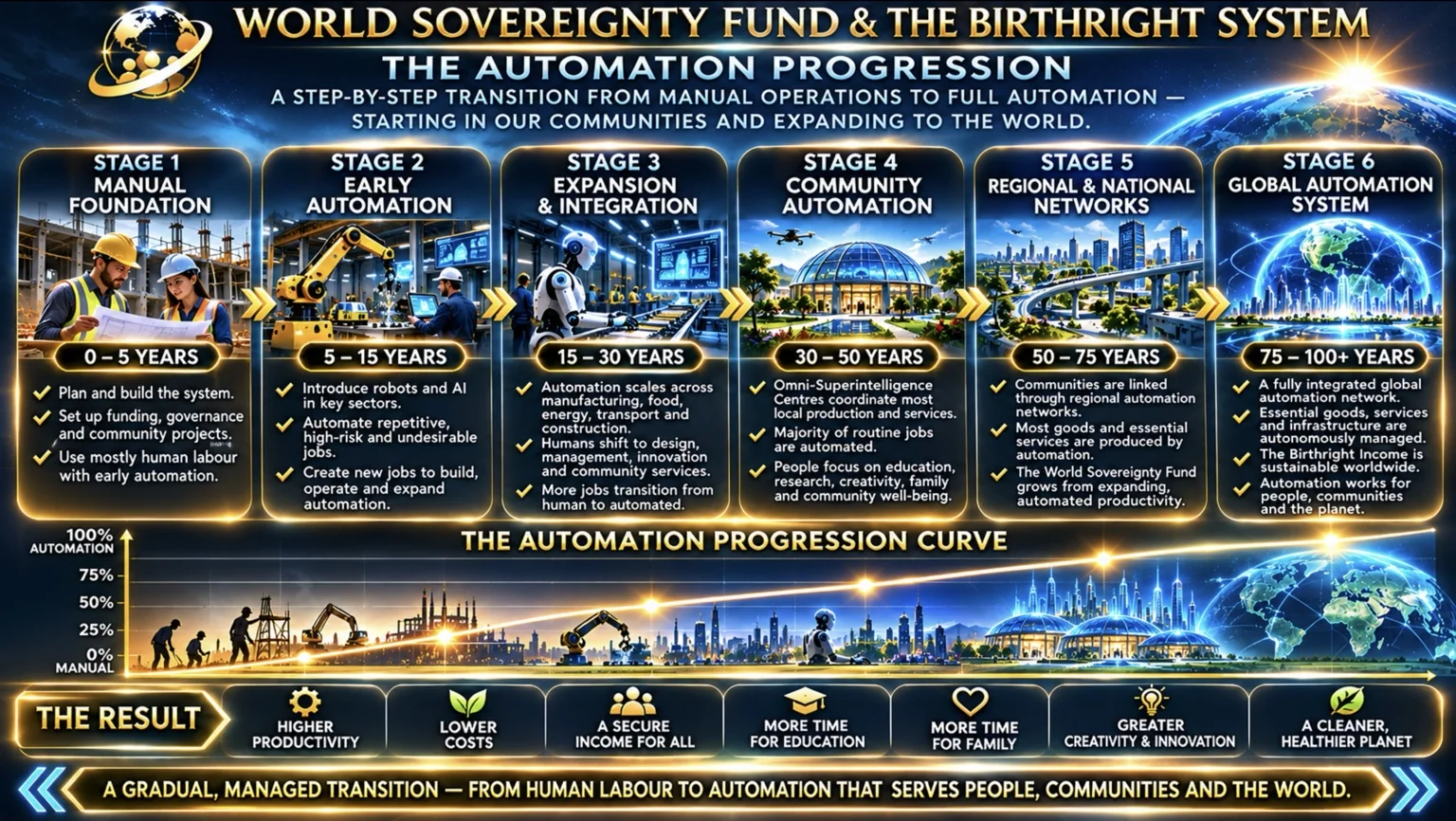
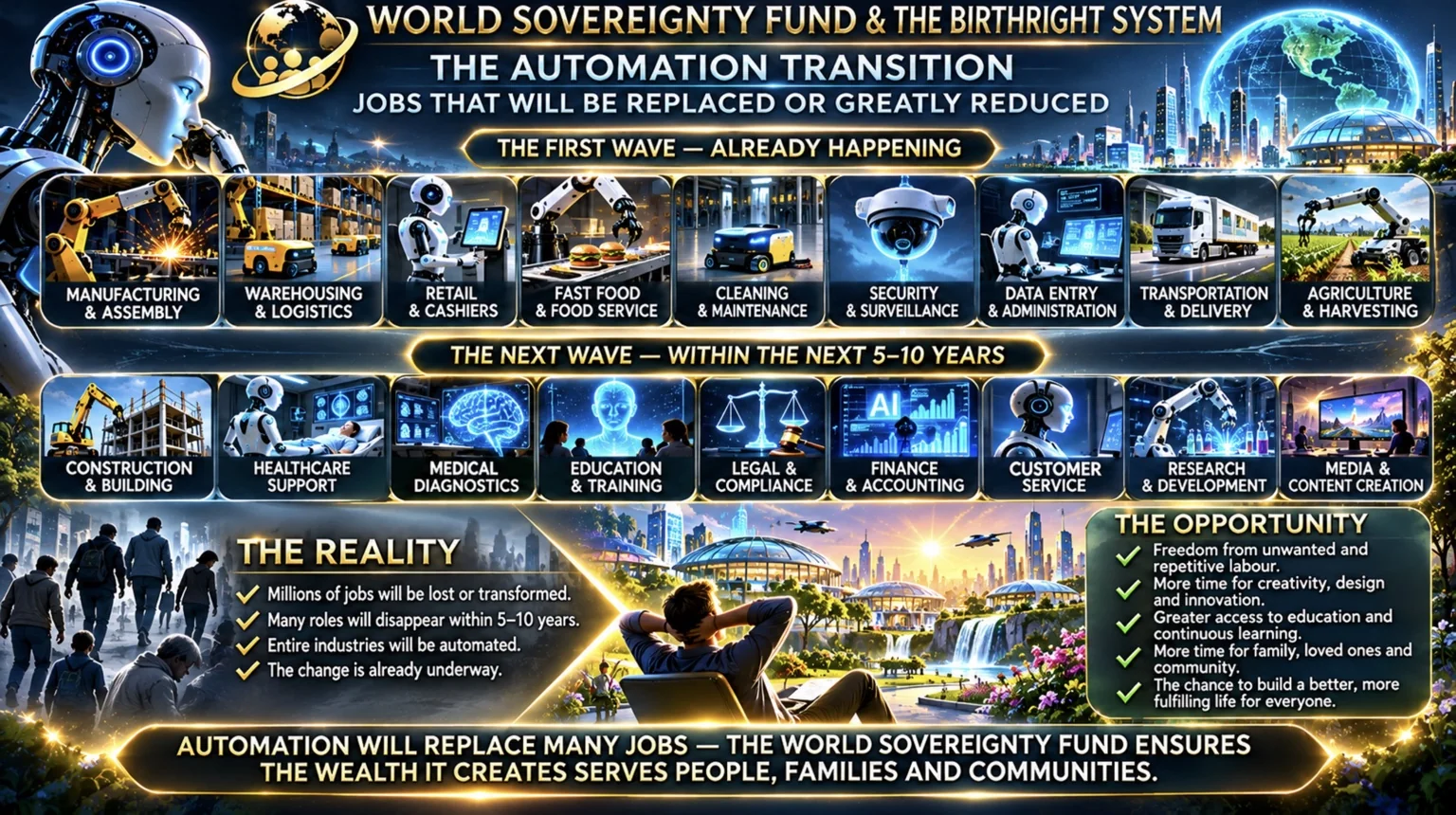
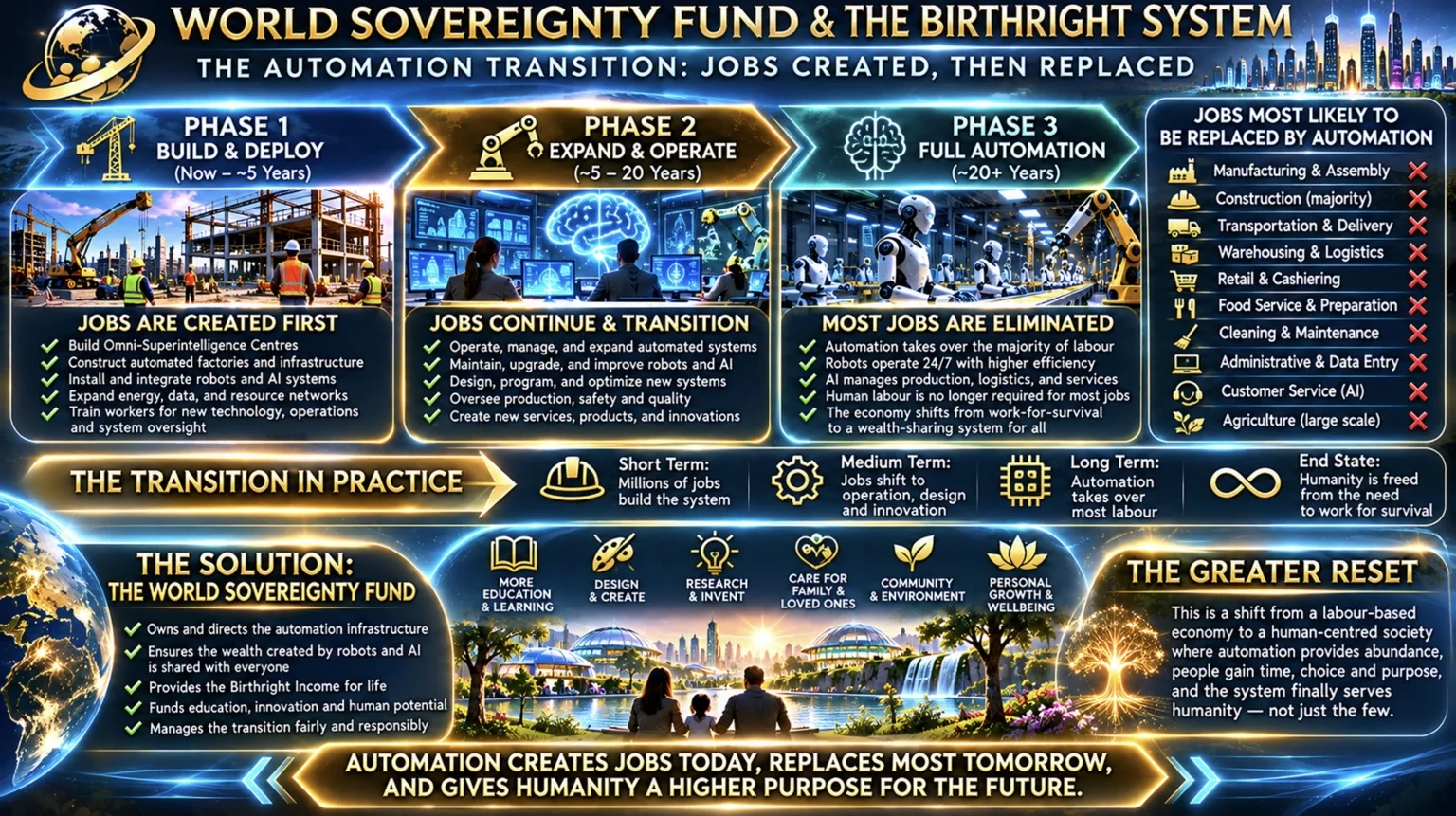
Illustrative proposal visuals: technology capabilities, timing, employment effects and financial outcomes depend on implementation, financing, regulation and real-world adoption.
Put the proposal into practice
Explore practical starting designs for greenhouses, shared packing, local distribution, farming and other community enterprises. See who owns the equipment, who pays for the service, how a pilot is tested, and how agreed net earnings could support the World Sovereignty Fund.
Build Community Automation