
Oxfam reported this increase in global billionaire wealth during 2024.
Oxfam · published January 2025Automation, ownership & the future of survival
When machines do the work,
how do people survive?
Imagine a world that can produce more than ever, yet leaves millions unable to afford a home, a meal, or a secure future. The machines keep working. The profits keep rising. But the people who once earned a living are left outside.
The evidence behind the question. This page also draws on USUS to SERVUS the DOMINIUM: Let the System Serve the People by Dennie Jared Frank. The book traces the connection between wages, rent, debt, and ownership, then proposes community-owned automation and a permanent fund as a different direction.
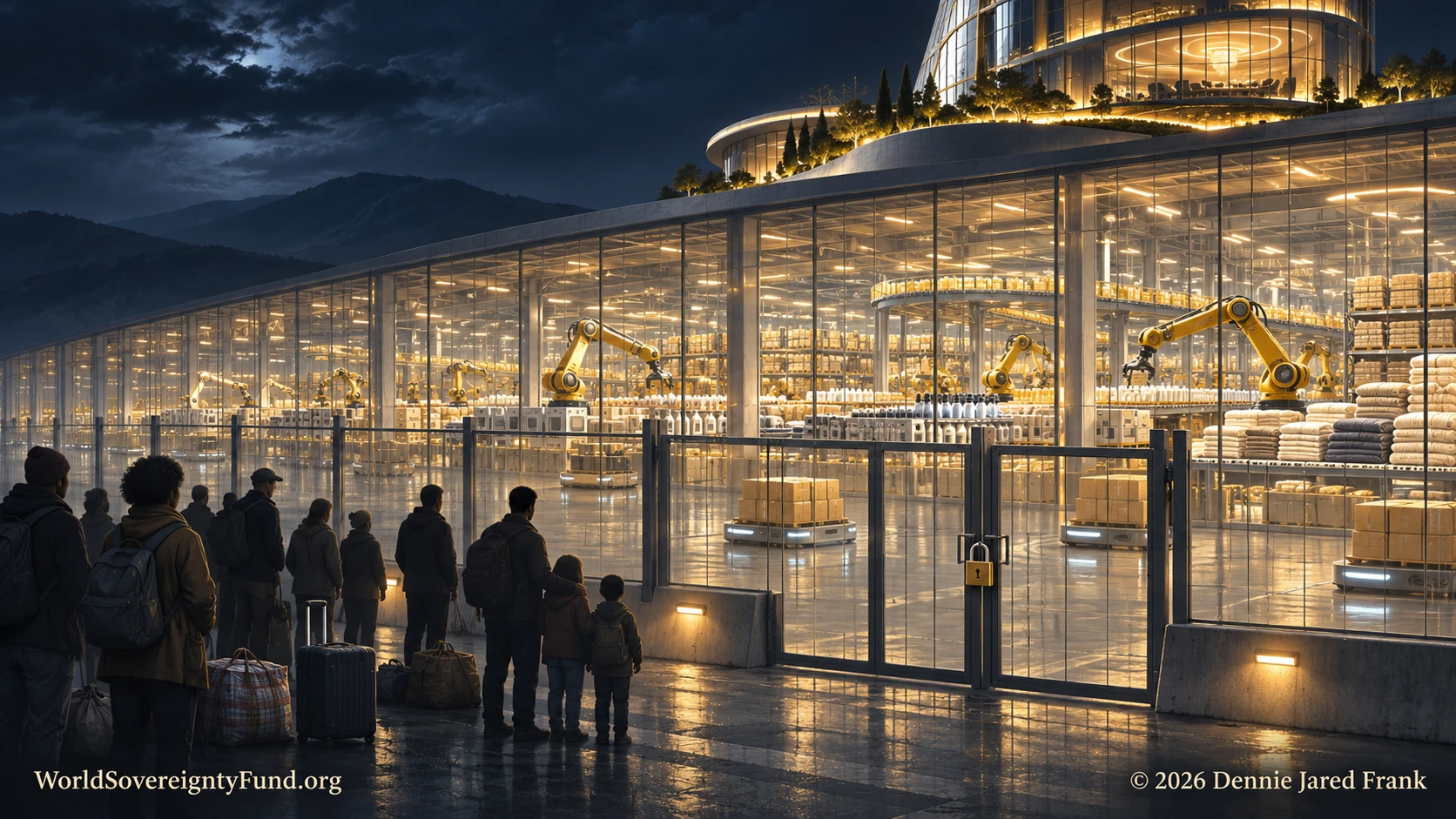
The starting point · reported figures
Wealth is already concentrated.
Automation raises the stakes.
Before looking ahead, we need to be precise about where we are starting. These figures describe billionaire wealth: the estimated value of assets after debts. They are not wages, cash sitting in a bank, or annual business profits.
Oxfam reported a further increase during 2025, taking its billionaire wealth estimate to US$18.3 trillion.
Oxfam · published January 2026Forbes estimated the combined wealth of 3,428 billionaires, using prices and exchange rates from March 1, 2026.
Forbes · published March 2026These are different dated estimates, not one continuous accounting series. The 2026 figure is total wealth; the 2024 and 2025 figures are reported increases. They should not be added together.
Reported wealth growth · Oxfam analysis published June 25, 2025
The richest 1% gained more than US$33.9 trillion in wealth since 2015.
Oxfam reported this increase in inflation-adjusted wealth in its June 2025 analysis. It concerns the richest one percent, a wider group than billionaires alone. It measures growth in net wealth, including changing asset values, rather than wages, annual business profits, or cash received.
The finding makes the ownership question concrete: when assets rise in value, the people who already own them can gain enormously. The question for automation is who will own the productive assets and receive their returns.
Oxfam, June 25, 2025: New wealth of top 1% surges by over US$33.9 trillion since 2015.What current research says. The International Labour Organization–NASK study published in May 2025 found that one in four jobs worldwide had some exposure to generative AI, with job transformation more likely than complete replacement. That is not evidence that all work will disappear. The scenario below deliberately asks what happens if future automation goes much further. Read the study summary.
Evidence discussed in the book
Who owns the wealth
before the next machine arrives?
The ownership gap is already measurable. The World Inequality Report 2026 describes the top tenth holding roughly three-quarters of personal wealth, while the poorest half holds about two percent. Its 2025 income estimates also show how unevenly the flow of earnings is divided.
| Population group | Share of personal wealth | Share of income |
|---|---|---|
| Top 10% | About 75% | 53% |
| Bottom 50% | 2% | 8% |
Figures are rounded; the wealth percentage follows the report’s executive-summary description of three-quarters. Income and wealth rankings are separate, so the people in each group need not be identical. The middle 40% is omitted from this comparison.
Source: World Inequality Report 2026, Chapter 1 and executive summary.The report also estimates that the richest one percent owns 37% of personal wealth. Ownership matters because an asset can provide returns and influence long after its owner has stopped working. Someone relying entirely on a wage has to keep finding a buyer for their labour.
A longer history
2018 report · 2016–2017 data
Growth can leave billions without greater wealth.
Oxfam’s Reward Work, Not Wealth estimated that the richest one percent received 82% of the increase in global wealth over its 2016–2017 comparison period, while the poorest half saw no increase in combined wealth. This concerns changing asset values, not a claim that poorer people received no income.
Read Oxfam’s January 22, 2018 release.Corporate ownership
2011 study · 2007 data
A familiar storefront can sit inside a much larger network.
Vitali, Glattfelder, and Battiston examined ownership connections involving 43,060 transnational corporations. Their model identified a tightly connected core of 147 corporations holding nearly 40% of the network’s estimated control over the economic value of the transnational corporations studied.
This is historical research on corporate ownership links. It is not a current measurement of all businesses, or the percentage of every purchase received by a particular asset manager. It shows why ownership deserves examination beyond the company name a customer sees.
Vitali, Glattfelder & Battiston, The Network of Global Corporate Control, PLOS ONE (2011).Automation and work
2020 research
Displacement has already had measurable effects.
Acemoglu and Restrepo’s study of US labour markets found that greater exposure to industrial robots reduced local employment and wages. The evidence concerns the places and period studied; it does not establish that every technology reduces employment everywhere.
Together with the generative-AI research above, this makes the question practical: when productivity changes who gets paid, what protects the people who lose income?
Acemoglu & Restrepo, Robots and Jobs: Evidence from US Labor Markets (2020).The connection explained in the book
The paycheque stops.
The claims on it continue.
Rent, mortgage payments, food, utilities, transport, and debt do not wait for someone to find another job. A household may have a legal right to refuse harmful work, yet little practical room to do so when the next missed payment threatens its home. Small businesses can face the same pressure through lenders, landlords, suppliers, and larger competitors.
“A person’s ability to refuse is one of the clearest measures of their freedom.”
Dennie Jared Frank · USUS to SERVUS the DOMINIUM · Work Wages And Debt
The book uses three terms to examine that dependence. They form the author’s framework for asking who uses essential assets, who must work to keep access, and who has the power to set the terms.
The ability to use.
A person needs somewhere to live, food to eat, and tools and services to participate in society. Using a necessity does not always mean owning it or controlling its price.
The pressure to keep serving.
Where access depends on the next paycheque, a person may have little room to leave an unsafe job, care for a relative, or recover from injury without financial consequences.
The power attached to ownership.
Owners can receive rent, interest, and profits and can influence the conditions of access. Automation changes the machinery, but ownership still determines who has a claim on its returns.
These terms express the book’s analysis of structural dependence. Present-day employment and debt are not legally identical to historical ownership of enslaved people.
From the manuscript · Who is the world indebted to?
Hundreds of trillions in debt.
Who holds the claims?
The book asks who ultimately receives the payments, who owns the financial claims, and how much influence accompanies that ownership. Its 2024–2026 passage reads:
“World debt is $251 trillion, in 2024–365.5 trillion in 2026 in public and private debt…”
Dennie Jared Frank · USUS to SERVUS the DOMINIUM
| Source and period | Reported total | What the measure covers |
|---|---|---|
| IMF · 2024 | US$251 trillion | Public and private nonfinancial-sector debt. |
| IIF · first half of 2026 | Above US$365 trillion | A broader debt measure that also includes financial-sector borrowing. |
The manuscript cites US$365.5 trillion for 2026; the IIF’s public September 2026 summary confirms a total above US$365 trillion. The IMF and IIF figures use different sector coverage. Their difference cannot be treated as a like-for-like increase in global debt, or as money earned by the richest people.
Debt is a claim, not the same amount in profit.
Borrowers owe payments to banks, bondholders, pension funds, public institutions, and other investors. A loan or bond is a liability for the borrower and a financial asset for its holder. Repaying principal is different from paying interest; neither the debt’s face value nor an increase in outstanding debt automatically measures a creditor’s net profit.
The ownership question still matters.
Debt can commit future income before a household receives it. When wages stop, rent, loan payments, and other necessities can remain. The book’s question is who has the power to set those terms, who receives the returns, and what protects people whose livelihoods are disrupted by automation.
The thought experiment
Suppose ownership stays at the top.
Imagine that a small ownership class controls the robots, computing infrastructure, energy systems, logistics, and platforms on which production depends. Machines gradually perform most paid work, and the owners receive most of the financial returns.
In this scenario, replacement jobs and public support do not expand enough to replace lost wages. We follow that possibility to its consequences, rather than treating it as an inevitable forecast.
If this path continues
Production rises.
Security disappears.
Under these assumptions, the crisis unfolds through ordinary household finances. People lose income before they lose their need for food, warmth, medicine, or shelter.
- 01
Work becomes harder to find.
Businesses automate tasks, reduce hiring, and shrink payrolls. Some people keep specialised or human-facing roles; others compete for a dwindling pool of paid work. Training helps where jobs remain, but cannot create enough positions by itself in the future assumed here.
- 02
Savings become a temporary wage.
Families use emergency funds, sell possessions, borrow, or depend on relatives. Rent and mortgage payments continue. Elderly people supporting adult children, disabled people, carers, and households without assets have fewer buffers when money runs out.
- 03
Abundance exists beside exclusion.
Food can still be grown. Buildings can still be constructed. Goods can still leave factories. Yet households without income cannot necessarily buy them. If housing remains unaffordable and support is inadequate, arrears, eviction, overcrowding, and homelessness can spread. Cheaper production helps only when savings reach people and essentials become affordable.
- 04
Ownership becomes power over access.
People become increasingly dependent on whoever controls necessities and financial support. If concentrated wealth also dominates public decisions, it can become oligarchy: power held by a small group. The danger is weakened bargaining power and accountability, alongside the loss of income.
The question that cannot be avoided
If wages disappear,
what replaces them?
For a time, people survive through remaining work, pensions, savings, family support, benefits, charity, or informal exchange. Those protections matter. But they cannot be assumed to cover everyone indefinitely.
If the scenario removes both sufficient paid work and sufficient access to shared output, many people cannot maintain a secure life. Debt does not replace a permanent income. Neither does being told to work harder when the jobs themselves have gone.
There is also an economic contradiction: businesses need customers. When households lose purchasing power, demand for mass-market goods can weaken even as productive capacity rises. Investment, exports, elite consumption, and government purchases may sustain some activity, but they do not automatically put food on every table.
People need a reliable claim on what society produces—through income, ownership, public provision, or a combination of all three.
A different direction
Automation can fund human security.
But the rules must make it happen.
Machines do not decide who receives the rewards. Ownership, public institutions, competition, and distribution rules do. A society can reduce compulsory labour while protecting people, if it builds a dependable way for the benefits to reach everyone.
A share in productive wealth
Community ownership, public investment funds, cooperatives, and broadly held equity can give people a stake in automation beyond their wages. Returns depend on real earnings and accountable management.
An income people can rely on
Dividends, social insurance, and a funded income floor can support purchasing power when employment is disrupted. A meaningful guarantee requires durable revenue, clear eligibility, and protection against inflation eroding its value.
Access to the essentials
Affordable housing, healthcare, food security, energy, education, and care services reduce the danger that losing a job means losing a home or basic dignity.
Power that remains accountable
Transparent finances, independent oversight, competition rules, worker participation, and enforceable public rights can limit the ability of concentrated wealth to control the terms of survival.
Practical examples examined in the manuscript
Sharing public wealth
already has working precedents.
The proposed World Sovereignty Fund would need to prove its own design. It can still learn from institutions and research that already exist.
Alaska: a dividend alongside employment.
Eligible Alaska residents have received annual Permanent Fund dividends since 1982. Jones and Marinescu’s published study found no significant reduction in overall employment and a 1.8 percentage-point increase in part-time work. This supports examining public dividends as a supplement to wages; it does not demonstrate a fully funded worldwide living income.
Jones & Marinescu, American Economic Journal: Economic Policy (2022).Norway: public wealth held across generations.
Norway transfers the state’s net petroleum cash flow into its Government Pension Fund Global. Transfers to the budget require a parliamentary decision, and withdrawals are guided over time by expected returns after inflation. It is a public investment and budget framework, rather than a universal personal dividend.
Norwegian Ministry of Finance, The Norwegian Fiscal Policy Framework.Income and real resources must grow together.
The manuscript makes a further point: a payment loses much of its benefit if housing, food, energy, and care remain scarce and prices rise. Shared income needs to be accompanied by useful production and affordable services. The goal is a secure life supported by actual homes, nourishment, power, care, and functioning communities.
The World Sovereignty Fund proposal
Build a share in the future
before people are excluded from it.
The World Sovereignty Fund and Birthright System propose a permanent fund that grows over time, including through agreed contributions from automation’s net earnings, with the long-term aim of supporting personal income, communities, and ecological protection.
The Birthright membership is intended to be personal and non-transferable. Any future payments would be ordinary, spendable money. The purpose is to build a stake in prosperity that does not depend entirely on competing with machines for a wage.
This is a proposed institution, not an income programme paying people today. Establishing it requires legal structure, participation, funding, oversight, and sustainable earnings. It would need other public protections alongside it; it is not an immediate substitute for housing or income support.
LET THE SYSTEM SERVE THE PEOPLE.
Community ownership means enforceable rights
Owning the robot must also mean
being able to run and repair it.
The manuscript argues that ownership must extend beyond the machinery itself. A community remains dependent if a supplier can prevent it from accessing the software, maintenance information, replacement parts, or operating data needed to keep its equipment working.
Useful machinery, selected locally.
Communities would identify needs in food production, housing, water, energy, maintenance, and ecological restoration. Equipment would be chosen for demonstrated usefulness, safety, and full lifetime cost.
Returns after the real costs.
Customers pay for useful goods and services. Energy, materials, repairs, reserves, and fairly paid human work must be accounted for before agreed net earnings can support the World Sovereignty Fund.
People who can challenge decisions.
Public accounts, independent audits, accessible appeals, and human authority over automated decisions would give participants a way to question administrators and correct harm.
A birthright that cannot be bought away.
The proposed membership remains personal and non-transferable. Future distributions would be spendable money. The membership itself would not be sold to someone able to purchase another person’s future claim.
Economic security must never become a reward for obedience.
As the book explains, an institution created to end dependence could recreate it if its administrators gain unchecked control. Protecting privacy, consent, essential services, and the right to challenge authority is part of the proposed system’s purpose.
The choice is about ownership and access
If machines can create abundance,
why should people be left without enough?
A future with less compulsory work could give people more time to care for loved ones, learn, create, recover, and contribute. That future depends on giving people a secure share in the wealth automation produces.
Sources and dates
- Oxfam: billionaire wealth in 2024. Published January 20, 2025. Supports the US$2 trillion increase.
- Oxfam: billionaire wealth in 2025. Published January 19, 2026. Supports the US$2.5 trillion increase and US$18.3 trillion total.
- Forbes: 2026 World’s Billionaires list. Published March 10, 2026; snapshot dated March 1. Supports 3,428 billionaires and US$20.1 trillion total wealth.
- International Labour Organization–NASK: Generative AI and jobs. Published May 20, 2025. Describes exposure to generative AI, not all forms of future robotics or a prediction of universal unemployment.
- Dennie Jared Frank, USUS to SERVUS the DOMINIUM: Let the System Serve the People, supplied manuscript. Sections used include “Work Wages And Debt,” “Community Ownership of Automation,” and the discussions of Alaska’s Permanent Fund and Norway’s public wealth fund.
- World Inequality Report 2026, Chapter 1 and executive summary. Supports the 2025 wealth and income shares.
- Oxfam, Reward Work, Not Wealth. January 22, 2018; historical 2016–2017 comparison.
- Vitali, Glattfelder & Battiston, The Network of Global Corporate Control. PLOS ONE, 2011; uses 2007 ownership data.
- Acemoglu & Restrepo, Robots and Jobs: Evidence from US Labor Markets. Journal of Political Economy, 2020.
- Jones & Marinescu, The Labor Market Impacts of Universal and Permanent Cash Transfers. American Economic Journal: Economic Policy, 2022.
- Norwegian Ministry of Finance, The Norwegian Fiscal Policy Framework. Public petroleum revenues, parliamentary budget transfers, and the fiscal rule.
- Oxfam, New wealth of top 1% surges by over US$33.9 trillion since 2015. Published June 25, 2025. Supports the inflation-adjusted wealth increase for the richest one percent; it is not an annual earnings measure.
All monetary figures on this page are US dollars. Reported wealth is not the same as cash income or realised profit. The future narrative is scenario analysis by Dennie Jared Frank. The assumption that most paid work disappears is illustrative, not a finding from these sources.
The future this proposal aims to make possible
These illustrations show the envisioned social benefits, rather than outcomes already achieved or guaranteed by the Fund.
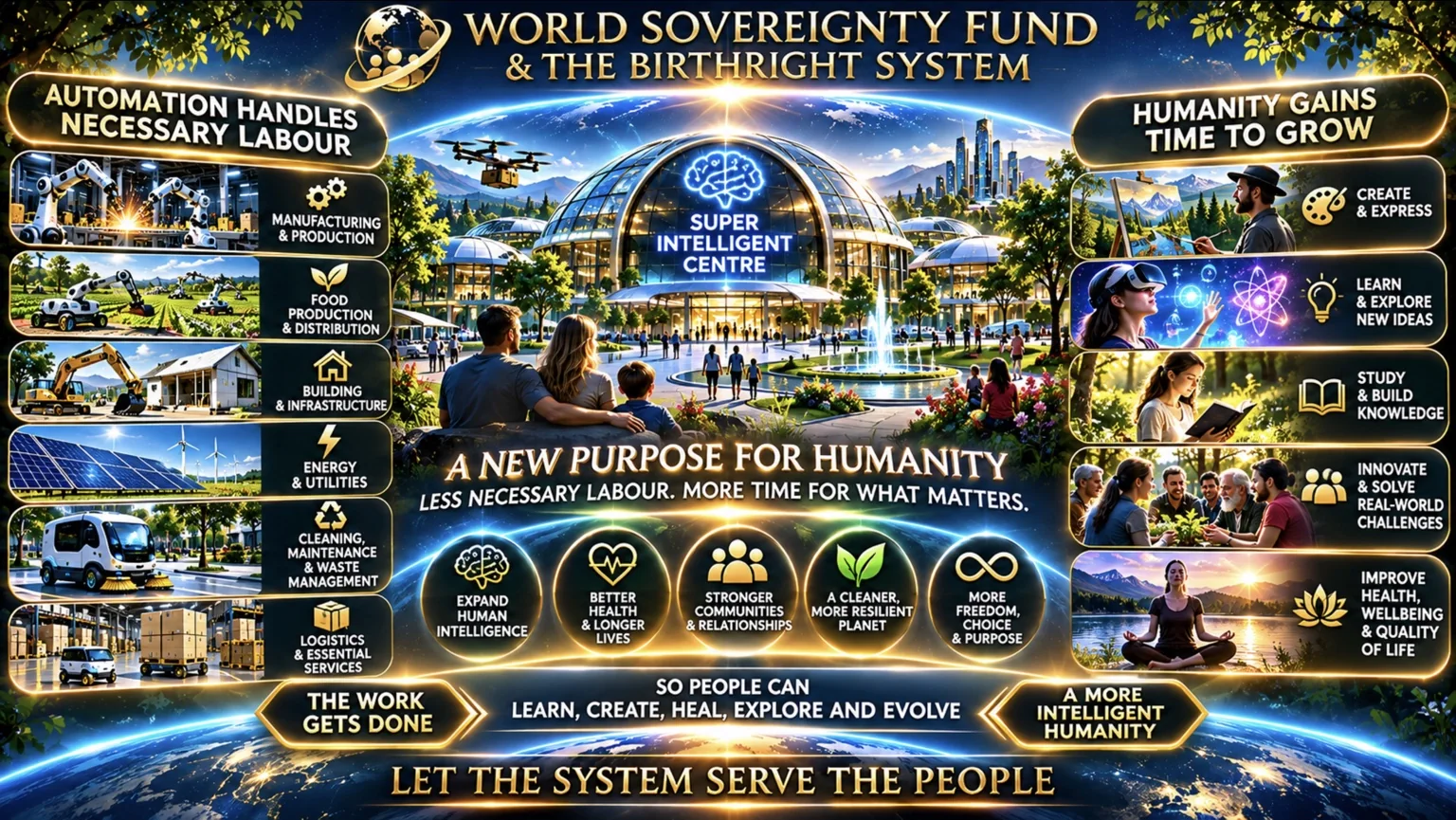
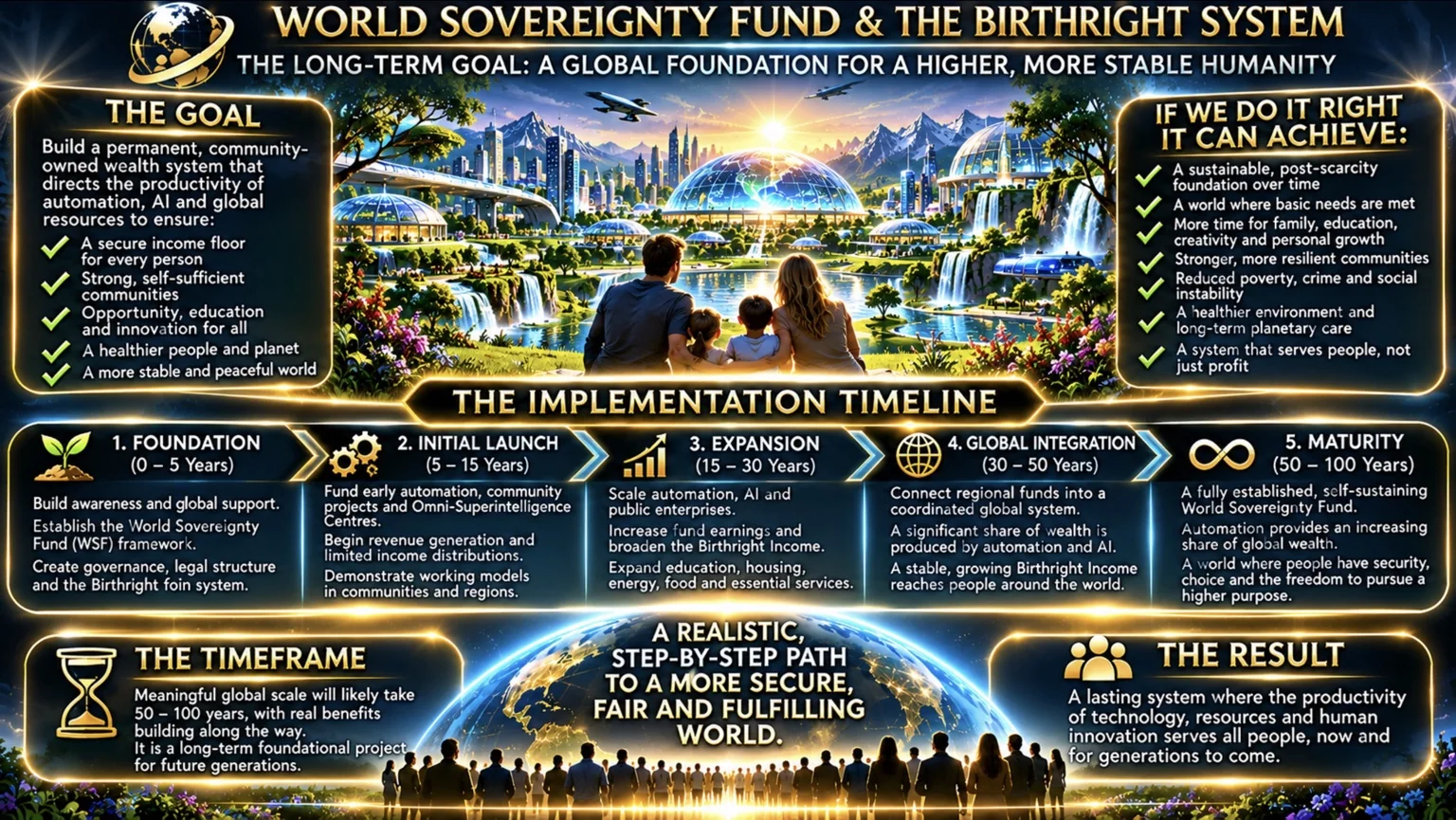
Illustrative proposal visuals: technology capabilities, timing, employment effects and financial outcomes depend on implementation, financing, regulation and real-world adoption.