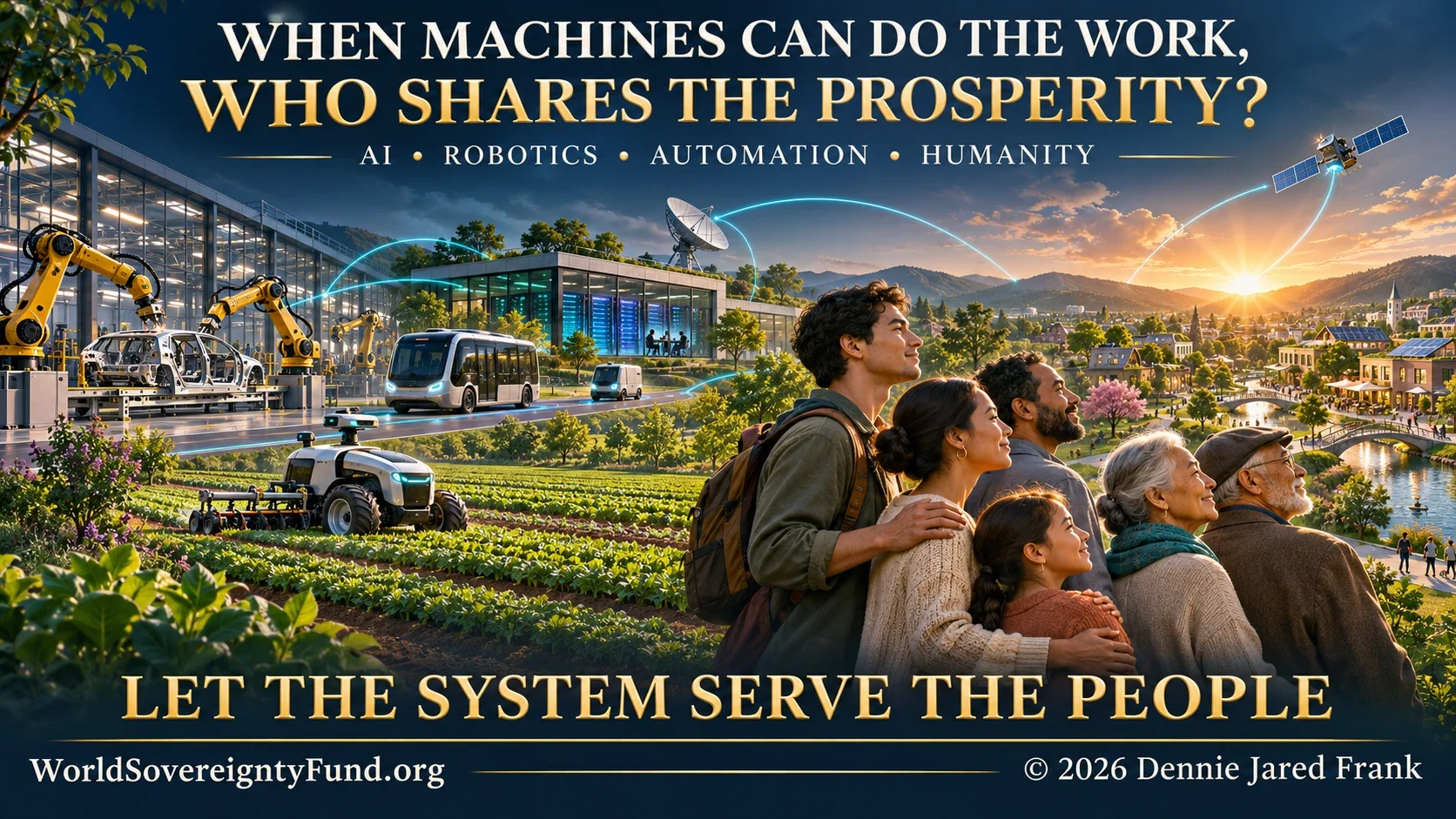
We built an economy where most people need income from work. What happens when businesses need less of our labour to produce more of our wealth?
SUPERINTELLIGENCE · An evidence-led guide by Dennie Jared Frank Research reviewed 13 November 2026 · Each statistic retains its source date.
What the evidence actually shows
The disruption is real. The outcome is still a choice.
Job cuts, weaker hiring, task exposure and robot installations measure different things. Read them together to understand the direction of change—without turning a forecast into a fact.
Showing all 9 evidence summaries.
Announced cuts · United States · 2025
54,836
Employers are already citing AI in layoff plans.
Challenger recorded 54,836 announced US job cuts that companies attributed to AI during 2025. These are announced plans and employer explanations—not an independently verified total of workers replaced by machines. Other business pressures can overlap.
AI can destroy demand for a business before it replaces its staff.
Chegg announced a reduction of approximately 388 employees, about 45% of its workforce. Reuters linked the restructuring to competition from AI tools and declining Google traffic. This illustrates business-model disruption, not 388 one-for-one robot replacements.
A missing first job can be an automation effect too.
Stanford researchers found employment among workers aged 22–25 in AI-exposed occupations was 19% below a comparison trajectory based on less-exposed peers, mainly through reduced hiring. They found no widespread economy-wide displacement. The patterns are descriptive, not causal proof; some differences predate generative AI and the results vary across datasets.
Industrial robots have already harmed some workers.
Acemoglu and Restrepo studied US robot adoption during 1990–2007 and estimated negative effects on local employment and wages. Their working-paper estimates associate one extra robot per thousand workers with a 0.18–0.34 percentage-point reduction in the employment-to-population ratio. This is historical, context-specific evidence, not a formula for every future robot.
The ILO–NASK index puts one in four workers worldwide in occupations with some generative-AI exposure. It identifies transformation as the more likely outcome for most affected jobs because human input remains necessary. Exposure means that tasks could be affected; it does not mean one quarter of workers will lose their jobs.
There can be job losses and job growth at the same time.
The World Economic Forum projected 92 million jobs displaced and 170 million created by 2030, a net gain of 78 million, across multiple economic trends—not AI alone. Its survey also records employers expecting AI-related staffing reductions. New jobs may require different skills or exist in different places from the jobs lost.
A majority of working time could be technically automatable.
McKinsey estimated that generative AI combined with other technologies could technically automate activities occupying 60–70% of employees’ working time. Its adoption scenarios placed automation of half of today’s work activities between 2030 and 2060. These are scenario-based task estimates, not a prediction that 60–70% of jobs will vanish.
Physical automation is already operating at industrial scale.
The International Federation of Robotics reported approximately 4.664 million industrial robots in operation worldwide in 2024, with around 542,000 installations that year. These machines are predominantly specialized industrial systems. Their number does not tell us how many jobs were lost.
AI is coordinating fleets, not just answering questions.
Amazon reported deploying its one millionth robot across a network spanning more than 300 facilities. Its DeepFleet model coordinates robot movements. That is evidence of integration and scale; the deployment report itself does not demonstrate an equivalent number of redundancies.
Can a task be automated? That is technical potential. Has the system been deployed? That is adoption. Did employment change? That is an observed outcome. Did automation cause it? That requires a stronger causal argument. A credible case for change keeps all four visible.
The whole automation landscape
Automation is bigger than AI. AI is bigger than a chatbot.
An automated system performs a process with less repeated human intervention. It may follow fixed instructions, learn patterns, generate content or act through machinery. These categories overlap; they are not a ladder where every system becomes conscious.
Software automation handles information. Physical automation moves or changes things. Intelligent automation connects perception, decisions and action. A simple conveyor and a sophisticated AI agent can both reduce work, even though their capabilities are completely different.
On small screens, scroll the tables sideways to compare the full descriptions.
Main families of automated and intelligent systems
System family
What it does
What that does—and does not—mean
Fixed & programmable automation
Timers, conveyors, CNC machinery, production lines and controllers execute defined sequences.
Work can be automated without any learning system or general intelligence. [15][22]
Process & infrastructure control
Sensors and control systems regulate machinery, building services, transport and industrial processes.
PLCs, SCADA and distributed controls concern physical operations; reliability and security are central. [15]
Workflow software & RPA
Scripts, APIs and software bots transfer records, fill forms and process routine transactions.
“Robotic” process automation is software. It does not require a physical robot or an LLM. [16]
Predictive machine learning
Models learn patterns to classify cases, forecast demand or identify anomalies.
A prediction depends on training data and deployment conditions; it is not an understanding of every situation. [17]
Deep learning, vision & speech
Neural networks support visual inspection, recognition and language processing.
These capabilities can feed a robot or a business workflow; a camera is a sensor, not intelligence by itself. [17]
Generative & multimodal AI
Models produce text, code, images, audio or video; multimodal systems work across more than one form of input or output.
Generating a convincing answer is different from verifying that it is correct. [18][26]
AI assistants & agents
Assistants respond to requests; agents can plan steps and use tools to pursue a goal.
Their reach depends on access, permissions, supervision and error handling—not merely a fluent conversation. [19]
Multi-agent & orchestration systems
Specialized agents or scheduling systems divide work and coordinate tools, robots and services.
Connecting multiple systems can extend a workflow. It does not automatically create AGI or superintelligence. [19][10]
Embodied AI & robotics
Software interprets sensor data and guides a machine’s movement or manipulation.
Physical tasks add constraints such as payload, grip, terrain, collision avoidance and maintenance. [22][23]
Connected operations
Networks link people, machines, data centres and remote supervisors.
Satellite internet, fibre and mobile networks carry information. They do not themselves supply the AI model. [24][25]
Learning methods are different from intelligence levels.
Supervised learning uses labelled examples. Unsupervised learning finds structure in data. Self-supervised learning builds learning targets from the data itself. Reinforcement learning uses feedback or rewards to improve a policy. These describe how systems are trained—not whether they possess human-level general intelligence.[17]
Capability, generality and autonomy
Powerful at a task. General across tasks. Beyond human capability.
Those are three different claims. There is no single universally accepted score that turns every AI system into a numbered intelligence level.
Established category
Narrow or specialized AI
A system designed or trained for bounded capabilities. It can outperform people in a particular domain without matching the breadth, adaptability or judgement of a person.
Contested research target
Artificial general intelligence
AGI broadly refers to flexible, human-level capability across a wide range of cognitive work. Definitions and tests differ. Strong performance on selected benchmarks is not universal proof of that breadth.
Prospective concept
Artificial superintelligence
ASI would exceed human capabilities broadly, rather than merely winning at a single task. Research examines possible pathways; this page does not claim that a verified, all-purpose ASI is already operating.
DeepMind’s research separates performance, generality and autonomy. Its proposed Levels of AGI framework is a way to discuss progress, not a universal certification. Its 2026 “From AGI to ASI” report studies possible future transitions.[20][21]
Autonomy is a separate dimension.
A human-operated surgical system can be technologically sophisticated while remaining directly controlled. A simple controller can operate automatically within a narrow boundary. More independence does not necessarily mean more intelligence.
Here, Omni-Superintelligence Centres means Dennie Jared Frank’s proposed community-owned centres for coordinating computing, AI and automation. It is a project concept, not an established scientific intelligence level or evidence that superintelligence has been achieved.
A machine does not have to become conscious to change who gets paid.
Different machines. Different capabilities.
The future of robotics does not have one shape.
Most useful automation does not need to look human. A gripper, a mobile platform, a harvesting machine or a software-controlled production line may be better suited to its job.
Robotic systems and related physical automation
Machine type
Typical work
Important boundary
Industrial arms
Articulated arms weld and handle parts; SCARA systems suit assembly; delta robots suit fast picking; gantries move along linear axes.
Specialized tools and workcells remain necessary. A robot arm is not an all-purpose worker. [22]
Collaborative applications
Robots and people share parts of a workflow, such as loading, positioning or assembly.
Safe collaboration depends on the full application and its controls, not just the label “cobot”. [27]
Guided vehicles & mobile robots
AGVs follow defined paths or guidance. AMRs navigate using sensing and onboard control.
Guided devices and autonomous robots have different navigation capabilities. [23]
Mobile manipulators & humanoids
Combine movement with grasping. Human-shaped systems may work around existing shelves, totes or tools.
A humanoid body does not establish human-level intelligence or general reliability. [11][23]
Field & agricultural machinery
Tractors, sprayers and material-hauling equipment automate defined outdoor tasks.
Conditions, supported implements and remote supervision matter. [13]
Autonomous road vehicles
A driving system can perform transport tasks within its supported operating domain.
A commercial robotaxi service is not proof that every road, weather condition or transport job is automated. [12]
Drones & inspection platforms
Flying, tracked or underwater systems can carry sensors for inspection and observation.
Some are remotely operated; others navigate automatically. Remote control and autonomy are different. [23]
Service & domestic machines
Cleaning, delivery, food handling and assistance are service-robot application areas.
A machine may perform one routine reliably while needing people for exceptions. [23]
Medical & assistive devices
Surgical instruments, rehabilitation systems and powered wearable devices assist people.
The FDA’s described robotically assisted surgical systems require direct surgeon control. [14][23]
Automated plants & infrastructure
Conveyors, process equipment and building controls can automate a site without humanoids.
Operations still require appropriate oversight, maintenance and cybersecurity. [15]
Commercial logistics
Humanoids moving totes.
GXO’s October 2026 announcement describes Digit moving totes onto conveyors in its existing Georgia operation. Expansion to two more sites was expected in early 2027. An operating task and a future rollout are different stages.
Waymo reported more than 250,000 paid weekly trips in May 2025 across four US markets. This dated example demonstrates deployment in defined service areas—not universal driving ability or a measured number of displaced drivers.
Deere’s 2025 announcement covered autonomous tractors, quarry hauling and commercial landscaping. It described remote monitoring and alerts. These are task-specific machines, not proof of completely unattended farms or construction sites.
The connection carries the signal. The intelligence decides the task.
In the proposed Omni design, Starlink could provide connectivity between centres, remote equipment and supervisors. Starlink itself is SpaceX’s satellite broadband network—not a superintelligent AI.
Starlink’s low-Earth-orbit network carries data. AI models process information. Coordination software assigns work. Local controllers move machines. Keeping these functions distinct makes the proposal technically understandable.[24]
A real example of the connection.
A Starlink case study describes Carbon Robotics using its service for agricultural equipment, fleet supervision and remote intervention across 15 countries. This is a vendor-reported example of satellite connectivity supporting robotics. It is not evidence that Starlink is an AI brain, or that it operates the proposed World Sovereignty Fund or Omni centres.
How a proposed connected Omni operation could work
Illustrative architecture for the proposal. Not a description of an existing WSF deployment or a Starlink partnership.
Connectivity
Starlink, fibre or mobile networks
Carry approved data between sites. Choice would depend on local service, resilience, cost and privacy requirements.
Computing & coordination
Omni centres
Run selected models and scheduling services, coordinate participating fleets and keep auditable records under accountable human governance.
Physical operations
Robots & local controllers
Perform authorized work using sensors, tools and task-specific safeguards. Fast safety controls should remain local so a dropped internet connection cannot remove safe stopping.
Accountability
People retain authority
Set permissions, review failures, maintain equipment and suspend unsafe operations. A public-benefit purpose must be built into ownership and enforceable rules.
No affiliation, endorsement or commercial agreement with SpaceX, Starlink or the companies cited is asserted.
From automated tasks to economic consequences
If automation can do most of the work, how will most people earn a living?
There is evidence for substantial technical potential and for specific employment effects. There is not conclusive evidence that a majority of all jobs will inevitably disappear, or a reliable date when that would happen.
Task substitution
Part of a job changes.
Software handles a routine case, or a machine performs a repeatable movement.
Workflow integration
Tasks connect.
Data, tools and machines cover more of a process, while people handle exceptions.
Organizational choice
Staffing can change.
A business may cut roles, leave vacancies unfilled, reduce hours or expand output with its existing team.
Economic adjustment
The gains are distributed.
Outcomes depend on demand, competition, ownership, worker power and public policy.
This is an explanatory pathway, not a forecast that every organization will follow the same sequence.
Why the risk can spread.
Language tools reach office work. Robots reach physical tasks. Sensors, networks and coordination software can join them into broader operations. If capabilities become reliable and cheaper than human alternatives, more businesses may substitute machines for labour. That is a conditional inference from the technologies described here—not proof of universal replacement.
Why capability is not destiny.
Costs, energy, maintenance, dexterity, unusual situations, customer trust, liability and regulation can constrain adoption. Higher productivity can also increase demand and create different work. A task automated in one occupation can create work elsewhere. The WEF’s 2030 scenario explicitly includes net job growth.
If a machine can produce the value, why should a human lose the means to live?
New jobs matter. So do the people who cannot move, retrain quickly, afford a gap in income or enter a field that has stopped hiring beginners. A growing economy can still leave particular workers and communities worse off. Preparing a public share does not require predicting the end of every job.
Majority of tasks is not majority of jobs.
Automating 60% of a role’s working time might reduce staffing. It might also improve service, expand output or change the role. Whole-job replacement requires dealing with the remaining tasks and the surrounding business. The McKinsey estimate is a reason to plan—not a certainty that the same percentage of people will be unemployed.
Let automation create prosperity. Build a way for humanity to share it.
The proposal is to add a public wealth system alongside private enterprise and existing banking. People could receive a stake in productive progress instead of relying entirely on the price of their labour.
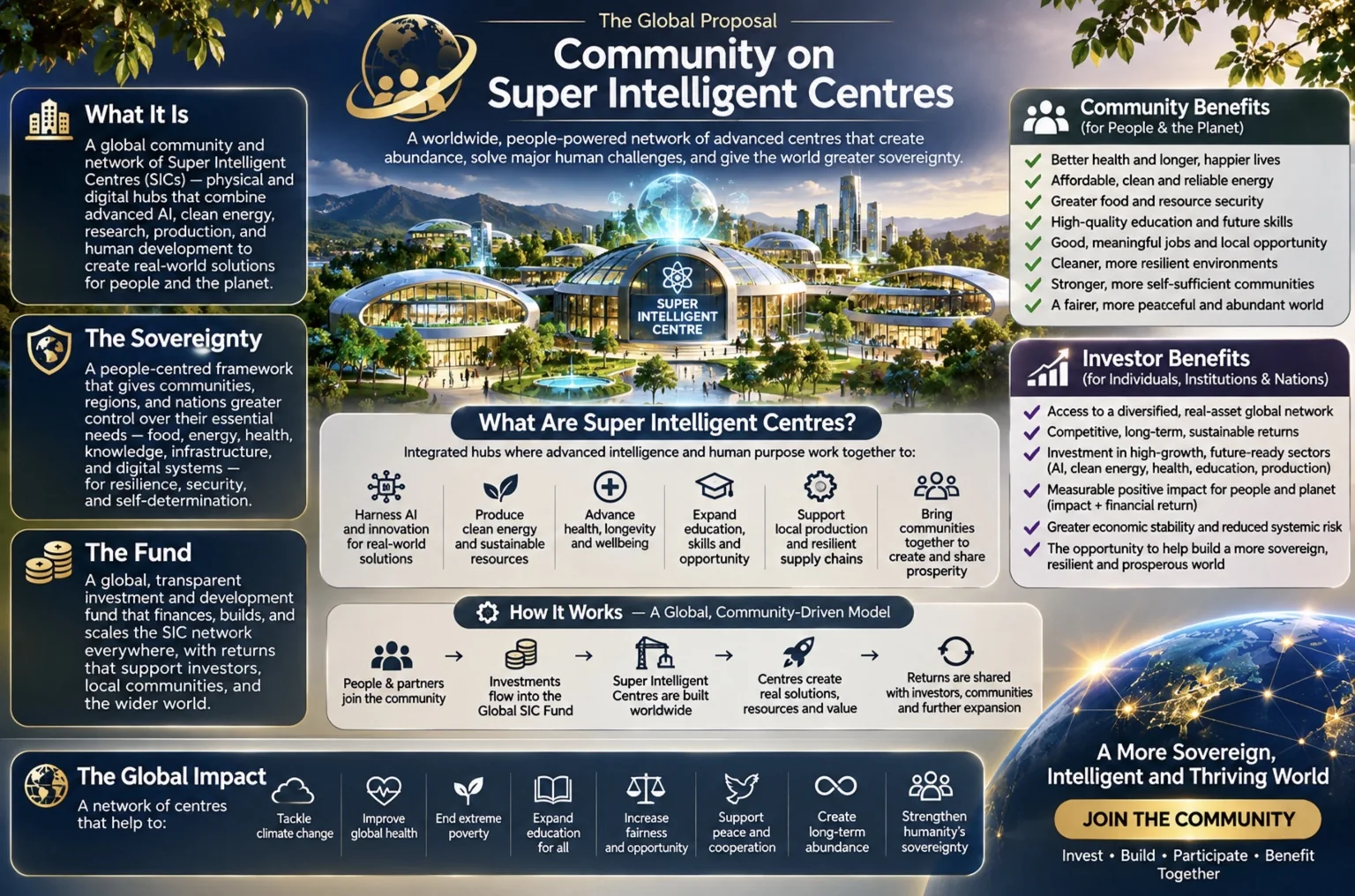
Omni-Superintelligence Centres are proposed as community-owned computing and coordination infrastructure. Participating enterprises could pay for services, operate automation and contribute an agreed share of verified net earnings. Today’s narrow AI and ordinary automation could support early pilots; the model should not depend on a speculative superintelligence breakthrough.
Keep the roles clear
Centres, businesses, banking and fund.
Omni centres would coordinate services. Businesses would produce goods or services and pay operating costs. The proposed Robot Banking layer would handle appropriately regulated financial infrastructure. The WSF would hold and invest public-benefit assets; it is not itself a bank.
Follow the actual money
Revenue is not a dividend.
Energy, wages, maintenance, equipment, financing, taxes and reserves must be covered before an agreed net contribution can reach the Fund. Investment losses and weak commercial results can reduce what is available. A robot does not produce free money.
Protect the human entitlement
A Birthright share.
The proposed Birthright Coin would represent a non-transferable lifetime entitlement, not a tradable asset. It could not be sold or pledged and would end at death. Any approved income would be ordinary spendable money.
Invest across generations
A permanent public asset base.
The proposed 70/20/10 allocation divides approved distributable earnings between people, communities and ecological protection. Payments depend on capital, sustainable earnings and policy. Meaningful worldwide scale could take 50–100 years or longer; this is a planning horizon, not a promise.
We do not need to strip the rich to build better systems.
A practical starting point is new public investment, voluntary participation, community-owned enterprises and negotiated revenue or equity arrangements. Private ownership and normal commercial returns can continue. Any future compulsory levy or estate contribution would require separate democratic and legal decisions; signing a petition does not enact it.
Young people: a future beyond competing with machines.
A successful public wealth system could help support education, retraining, housing stability and time to build a life. It would not replace the need for opportunity, skills or fair working conditions. Its purpose is to widen the options when employment alone cannot provide security.
Older people: progress that supports dignity.
Over time, sustainable public income and community investment could complement retirement resources, improve access to services and give families more room to care for one another. Older people should not have to become obsolete for technology to become useful.
Business owners and the wealthy: customers with purchasing power.
One intended benefit is a more resilient customer base, healthier communities and wider acceptance of productive technology. That could support investment and enterprise. These are proposed benefits to test—not demonstrated returns from a system that has not been built.
Humanity: contribution with more meaningful choice.
Automation could reduce dangerous, exhausting or repetitive work while enabling more care, learning, creativity and restoration. Achieving that outcome requires explicit ownership, distribution and environmental rules. Technical progress alone does not decide who benefits.
The aim is not to make people unnecessary. It is to make insecurity unnecessary.
This section explains the proposal and its intended benefits. The external studies on this page do not validate the financial viability, governance or delivery of an unbuilt global institution. Pilots, independent audits and public scrutiny are necessary.
The questions that should stay with us
What does freedom mean when survival has an entry price?
If you choose not to participate in paid work, is there a meaningful way to keep food, shelter and security? If automation removes the work you can get, does that choice still belong to you?
Dennie Jared Frank’s argument about structural forced labour concerns that dependence: people can have formal freedom while facing severe pressure to accept terms they cannot realistically refuse. Calling it “disguised slavery” is a moral and political critique, not a claim that every worker, homeowner or wealthy person is legally enslaved.
Income insecurity can constrain people with little wealth. Debt, recurring costs and fear of losing status can also shape the choices of people with more. Those pressures are unequal. Recognizing them should strengthen the case for better systems, without erasing the enormous difference between having resources and having none.
Does this prove most jobs will disappear?
No. It establishes real deployment, specific labour-market effects and substantial potential to automate activities. It does not establish an inevitable majority-job-loss outcome. The strongest question is whether society is prepared if wage income becomes less dependable.
Is Starlink Omni Superintelligence?
Starlink is the satellite communications network. In this proposal, it could connect Omni centres and equipment. The proposed Omni computing and coordination systems would be a separate layer. There is no asserted partnership, and internet connectivity is not proof of superintelligence.
Do we have to wait for AGI or humanoid robots?
No. Ordinary software, existing industrial equipment and task-specific AI can already automate useful work. Public-benefit pilots could use commercially available tools and measure their costs, risks and net value.
What would signing the petition actually support?
Public interest in further assessment and development of the World Sovereignty Fund and Birthright proposal. A signature is not an investment, a guaranteed payment or proof that the system will be adopted.
What should a serious pilot measure?
Full costs and maintenance, productivity, safety failures, worker transitions, net contributions, audited distributions, privacy, energy use and the ability of people to challenge decisions. Publish the failures as well as the successes.
Your signature can help start the conversation
If machines can create the wealth, let the system serve the people.
Support serious assessment of a public share in automation: accountable institutions, sustainable funding and a protected human stake in the future.
LET THE SYSTEM SERVE THE PEOPLE
Signing expresses support. It does not guarantee adoption, funding, an income amount or a payment date.
Evidence you can inspect
Read the research. Check the claims.
Primary research, official deployment reports, a company filing and independent news. A company announcement demonstrates what the company reports; it is not independent proof of job displacement.
Sources reviewed 13 November 2026. Figures are dated observations or forecasts, not live counters. Links open the original publisher. The numbered references throughout the page jump here.
ILO–NASK20 May 2025 · Occupational exposure studyGenerative AI and jobs: A 2025 updateMeasures potential task exposure, not a count of redundancies.
Stanford Digital Economy Lab12 August 2026 revision · US payroll researchCanaries in the Coal Mine?Descriptive evidence through June 2026; the authors do not claim a causal estimate.
Challenger, Gray & Christmas2026 report · Announced US layoff plansJanuary job cuts reportTracks companies’ stated reasons for announced cuts; does not independently establish AI causation.
Chegg / US SEC27 October 2025 · Company filingForm 8-K: restructuring announcementPrimary confirmation of a planned 388-person reduction; see Reuters for the commercial context.
Acemoglu & Restrepo / NBER2017 working paper; published 2020 · Labour-market researchRobots and Jobs: Evidence from US Labor MarketsHistorical US industrial-robot evidence from 1990–2007; not a universal robot-to-job conversion.
World Economic Forum7 January 2025 · Employer survey and projectionsThe Future of Jobs Report 20252030 expectations across multiple economic trends, including both job creation and displacement.
McKinsey Global Institute2023 · Technical-potential modellingGenerative AI and the automation of work activitiesEstimates automatable activities and time; neither a forecast of the same percentage of jobs lost nor a guarantee of adoption.
International Federation of Robotics25 September 2025 · Deployment statisticsWorld Robotics 2025: industrial robotsReports 2024 industrial installations and operational stock, not employment effects.
Amazon30 June 2025 · Company deployment reportOne million robots and the DeepFleet modelA company’s account of its fleet and coordination technology; not independent evidence of layoffs.
GXO / Agility Robotics26 October 2026 · Commercial deployment announcementHumanoid partnership expands to additional sitesDistinguishes an existing tote-handling operation from additional deployments expected in 2027.
Waymo5 May 2025 · Company deployment reportScaling our fleet through US manufacturingA dated example of paid autonomous rides; not a current fleet count or proof of universal road autonomy.
John Deere6 January 2025 · Product announcementNew autonomous machines at CES 2025Describes equipment and remote supervision; an announcement does not establish adoption everywhere.
US FDAOfficial medical-device guidance · Accessed 13 November 2026Computer-Assisted Surgical SystemsExplains the direct surgeon control used in the robotically assisted systems discussed.
NISTOfficial operational-technology overview · Accessed 13 November 2026Operational technologyExplains programmable systems controlling physical processes, including buildings and transport.
IBMTechnical explainer · Accessed 13 November 2026Robotic process automationDistinguishes rule-following software bots from AI; these are not physical robots.
IBMTechnical explainer · Accessed 13 November 2026Artificial intelligenceExplains machine learning, deep learning, language and vision capabilities.
IBMTechnical explainer · Accessed 13 November 2026Generative AIDescribes generated text, code, images, audio, video and foundation models.
IBMTechnical explainer · Accessed 13 November 2026AI agentsExplains tool use, planning and workflows; autonomy depends on tools, permissions and system design.
Google DeepMind2023 paper; 2024 publication page · Research frameworkLevels of AGIA proposed research framework, not a universal official ladder or a certification that AGI exists.
Google DeepMind12 June 2026 · Prospective researchFrom AGI to ASIInvestigates possible pathways to superintelligence; does not demonstrate an existing ASI.
International Federation of RoboticsOfficial taxonomy · Accessed 13 November 2026Industrial robot definitions and structuresExplains articulated, Cartesian/gantry, SCARA and parallel/delta manipulators.
International Federation of Robotics2025 · Definitions and methodologyService, mobile and medical roboticsSeparates autonomous robots, guided vehicles, teleoperated devices and wearable robots.
Starlink / SpaceXOfficial technology overview · Accessed 13 November 2026Starlink satellite technologyStarlink provides satellite broadband; connectivity and artificial intelligence have distinct functions.
Starlink / Carbon RoboticsCompany case study · Accessed 13 November 2026Agricultural robotics connected through StarlinkA vendor-reported example of connectivity, fleet supervision and agricultural robotics working together.
NIST26 July 2024 · AI risk framework companionGenerative Artificial Intelligence ProfileProvides a basis for evaluating and managing generative-AI risks rather than assuming fluent outputs are reliable.
International Federation of RoboticsOfficial overview · Accessed 13 November 2026Collaborative robotics and service robotsExplains collaborative applications and the distinction between industrial, service and medical robots.
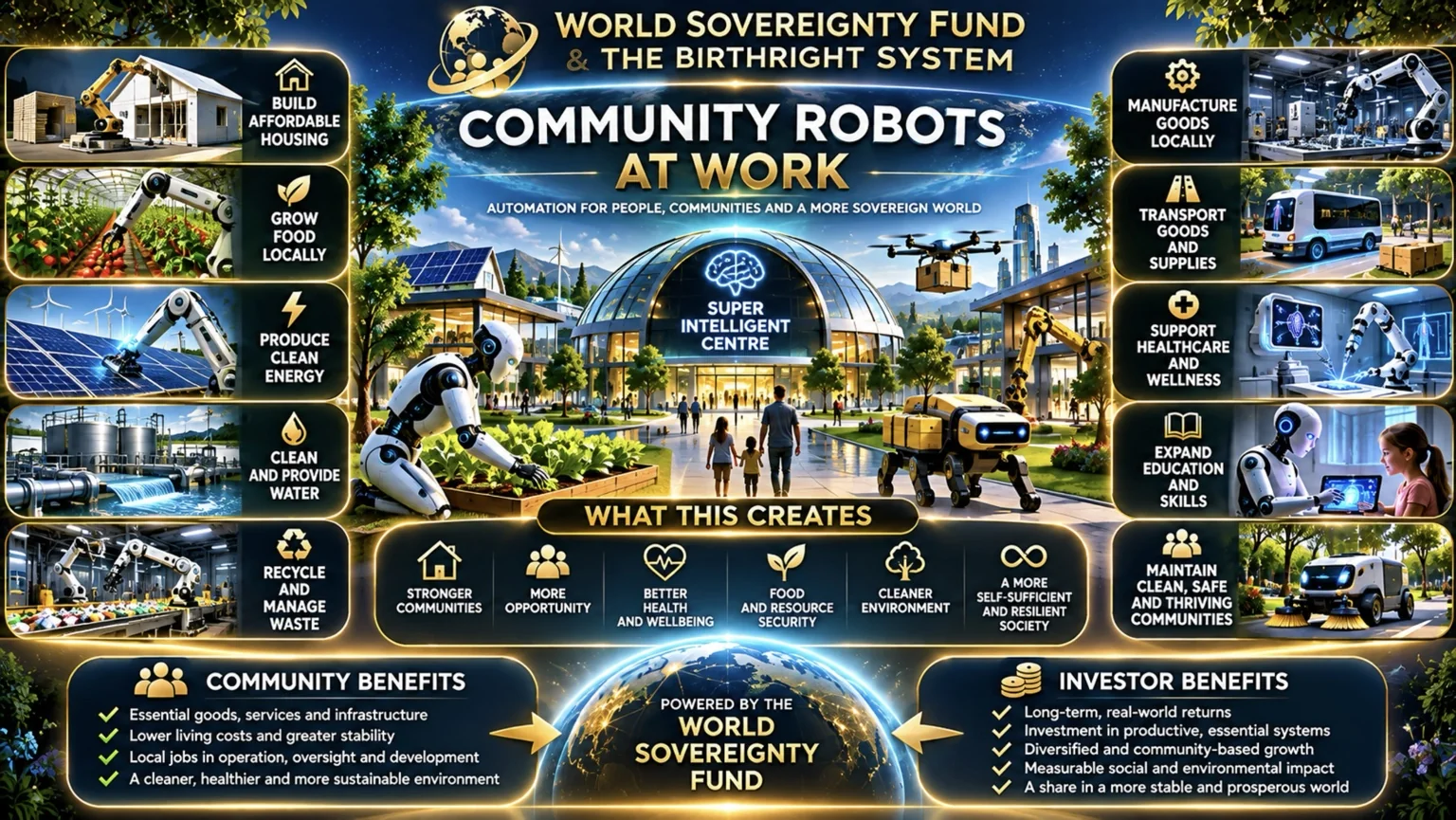
Community-owned automation in practice
The proposed Omni-Superintelligence Centres would coordinate services, infrastructure and production while remaining accountable to communities.