Skip to content
A future worth building. Together.Support on GoFundMe
WORLD SOVEREIGNTY FUND& THE BIRTHRIGHT SYSTEM
Explore all topics

World Sovereignty Fund · The evidence and the case

Build prosperity
that more people
can own.

If technology can create more wealth, how do we make sure it creates a more secure life for humanity?

Keep private enterprise. Build lasting public wealth. Give progress a wider circle of beneficiaries.

Evidence supports important building blocks. The complete World Sovereignty Fund remains a proposal that needs legal establishment, capital, independent scrutiny and practical trials.

ENTER THE EVIDENCE CHAMBER — PROVE, DON’T DEFEND
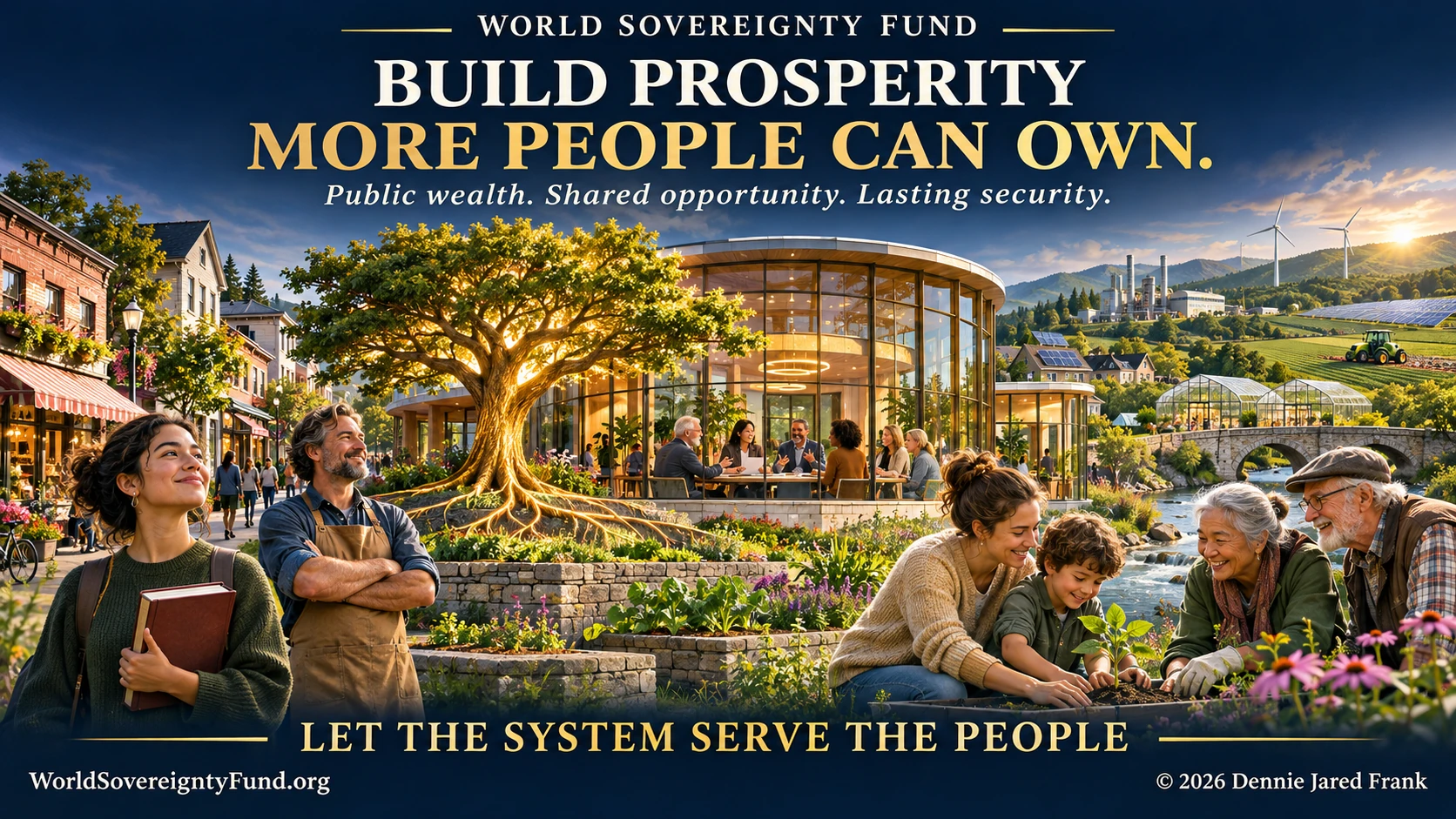
World Sovereignty Fund: build prosperity more people can own. Public wealth, shared opportunity and lasting security. People of all generations in a thriving community. Let the system serve the people. WorldSovereigntyFund.org. Copyright 2026 Dennie Jared Frank.

An argument you can examine

The evidence is strong enough
to justify building carefully.

Public investment funds, income security and shared returns are real subjects of research and public policy. The task is to assemble their useful lessons into an institution people can trust.

EstablishedPublished findings and operating institutions show what has already been observed.
ReasonedDesign implications explain why those findings matter to this proposal.
To be demonstratedThe WSF’s own funding, governance, payments and wider effects must be tested in practice.
Work is changingILO / NASK · 2025

Prepare for changed work before insecurity becomes the plan.

The ILO’s task-based assessment places about a quarter of global employment in occupations with some generative-AI exposure. Its central expectation is that many jobs will change rather than disappear, because human input remains important.[1]

Design implication: strengthen people’s ability to retrain, change jobs and share in productivity gains. The case for preparation does not require predicting that every occupation will vanish.

Scope: generative-AI task exposure is neither a job-loss forecast nor a measurement of every form of robotics and automation.

Ownership mattersWorld Inequality Report · 2022

The starting line is already unequal.

The report’s estimates for 2021 put 76% of global household wealth with the wealthiest tenth of adults and 2% with the bottom half. These are dated estimates of wealth shares, rather than a claim about today’s exact distribution.[2]

Design implication: create additional public and community ownership so future productive wealth can reach people who begin with little capital. This can start by building new assets and negotiating participation.

A public fund can endureNorway · Operating precedent

Turn a temporary revenue stream into a lasting public asset.

Norway’s Government Pension Fund Global converts petroleum-related public revenue into long-term financial wealth. Its fiscal framework guides spending by expected real returns over time and allows adjustment across economic conditions.[3]

Design implication: a society can save and invest collectively for future generations. The proposed WSF would need its own lawful revenue sources, investment mandate and spending discipline.

Norway’s fund supports its public budget. It is not a global basic-income scheme, and its performance cannot be promised for a new fund.

Income and contributionAlaska · Published study, 2022

A public dividend did not make employment collapse.

Jones and Marinescu’s study of Alaska’s annual dividend found no effect on overall employment and an increase of 1.8 percentage points in part-time work. The research used a synthetic-control comparison, rather than a randomised statewide experiment.[4]

Design implication: receiving an unconditional share of public wealth can coexist with paid work. Income security and contribution do not have to be opposing goals.

A modest annual dividend does not establish the effects of a large worldwide income floor, a different funding method or a different economy.

Security has human valueFinland · Evaluation, 2020

Measure whether people gain breathing room.

Finland’s basic-income evaluation reported better perceived financial security and mental wellbeing among surveyed recipients. Employment effects were small; a separate activation-policy change complicated interpretation of the second year.[5]

Design implication: evaluate stress, autonomy and the ability to plan alongside employment. An institution meant to serve people should measure people’s lives.

The two-year experiment involved unemployed adults. Its survey findings and particular design cannot establish universal lifelong effects.

Cash can improve essentialsWorld Bank · Evidence synthesis, 2024

Financial security can become practical opportunity.

The World Bank’s synthesis describes benefits across cash-transfer programmes in areas including poverty, food security and some health and nutrition outcomes. Predictable support can also help households plan and invest. Outcomes depend on programme design and local conditions.[6]

Design implication: ordinary spendable money can support everyday priorities and longer-term choices. It should sit alongside functioning housing, healthcare, education and infrastructure.

Evidence from varied programmes supports possibilities, not a guarantee that one payment design will deliver every benefit everywhere.

Care already creates valueILO · 2023 estimates, released 2024

Human worth cannot be reduced to a payslip.

The ILO estimated that unpaid care responsibilities kept 708 million women and 40 million men outside the global labour force in 2023. These estimates concern participation in paid work; they do not mean those people were inactive or making no contribution.[7]

Design implication: a protected income share could give carers more financial independence. Quality care services, fair pay for care workers and support for people receiving care remain necessary.

“A civilisation should be able to become more productive while giving its people more security, more time and more freedom.”

The purpose behind the World Sovereignty Fund proposal · Dennie Jared Frank

The organisation, clearly explained

One purpose.
Different institutions with defined jobs.

The World Sovereignty Fund would hold and grow shared wealth. The Birthright System would connect people to approved distributions. Banking, automation operations and public oversight have separate responsibilities.

Part of the proposed frameworkIts job
World Sovereignty FundA proposed permanent public wealth fund. It would receive lawful contributions, own or invest in assets, manage capital and approve sustainable distributions. The Fund is not itself the proposed bank.
Existing banks and private enterpriseContinue operating. Businesses can earn profits and invest in automation; existing financial institutions can provide finance and ordinary banking services.
Robot Banking SystemA separately established financial and payment structure for automation-related activity, subject to the authorisations its services require. It would manage payments and agreed transfers; its name does not create money or funding by itself.
Community-owned Omni-Superintelligence CentresThe proposal’s name for community-controlled computing and automation-coordination centres. They would need real services, customers, qualified human oversight and secure operation. The name is not evidence that such superintelligence already exists.
Participating enterprisesProduce useful goods and services. Revenue covers operating costs, maintenance, reserves and agreed owner returns before an agreed net contribution reaches the Fund.
Birthright System and Birthright CoinOne protected, non-transferable lifetime membership per eligible person. The membership could not be sold, traded or pledged. Approved benefits would arrive in ordinary spendable money. The entitlement ends at death; broader inheritance reform is a separate policy question.
Independent governance and public oversightProtect capital, publish accounts, manage conflicts, oversee technology, hear complaints and protect participant rights. The proposed permanent board has 15 seats spanning community, finance, law, technology, environment and participant rights.

This is a description of Dennie Jared Frank’s proposed framework, not a statement that these institutions are established or paying benefits today.[13]

Follow the money

The promise must fit the productive wealth.

A machine creates a financial contribution only when its useful output earns revenue after the full costs of producing it. Investment returns can vary. Payments must follow verified resources.

The proposed allocation of approved distributable resources is 70% for personal income, 20% for community development and 10% for ecological stewardship. These shares describe how available resources would be divided; they do not guarantee an amount or a start date.[13]

70%Personal income20%Community development10%Ecological stewardship

An illustration you can check

What could a funded dividend support?

Change the assumptions to see the scale of capital required. This illustrates a fund-backed payment; it does not calculate a promised benefit.

Illustrative personal payment, using the proposed 70% share$175 / month
Total fund capital needed for $1,000 per person per month at the selected rate$57,142,857,143

Monthly personal payment = capital × assumed distributable rate × 70% ÷ participants ÷ 12.

Illustration only. Returns, capital raised and benefits are not guaranteed.

A dividend and a guaranteed income floor are different commitments. A dividend depends on available distributable resources. A guaranteed floor also needs a dependable funding backstop, legal commitments and reserves. Early capital-building and sustainable spending would come before meaningful worldwide payments.

A fair proposal must answer each generation

Different lives.
A shared interest in greater security.

Support has to be earned. No age group or level of wealth can be assumed to agree. The case becomes stronger when people can see the practical benefit, the cost and the safeguards.

Young people

A future you can enter
with a stake in it.

A funded Birthright share could give younger people a financial foundation alongside paid work: more room to train, change careers, build a business or care for family as technology changes. Shared community investment could also support housing, transport, connectivity and education.

The deeper attraction is ownership across time. Each new generation would enter a fund built by earlier generations, rather than beginning every technological transition with only its labour to sell. That is an ambition requiring capital and participation, not a cheque already waiting.

What could earn their acceptance: an entitlement that cannot be bought away, clear protections for personal freedom and privacy, open accounts, a credible funding path and a real voice in governance. Trust would depend on those conditions being delivered.

Baby boomers and older adults

Security for later life.
A legacy beyond it.

Older people could benefit from viable community projects that improve affordable housing, accessible transport, energy security and care. Income security for adult children could also give families more room to support loved ones. People who are still working could gain more flexibility as their health or responsibilities change.

A long-term global fund cannot honestly be sold as immediate retirement relief. Current needs require properly funded near-term services and existing pension protections. Its intergenerational case is to build assets and institutions that children and grandchildren can inherit collectively.

What could earn their acceptance: protect existing pensions and disability supports, publish the cost of local projects, preserve lawful private savings and estate rights, and distinguish achievable early benefits from a worldwide goal that may take generations.

Business owners and the very wealthy

Prosperity has a stronger future
when people can participate in it.

Large asset owners—including those often described as oligarchs—have commercial reasons to consider a broader prosperity model: customers with purchasing power, skilled people able to retrain, functioning infrastructure and clearer rules for long-term investment. These are economic arguments for cooperation, not guaranteed returns from the WSF.

Private owners could retain existing lawful assets and participate in new productive ventures with transparent contracts, costs and agreed returns. A public stake in some future automation earnings can grow alongside private enterprise. Broader ownership does not require an across-the-board seizure of private fortunes.

What could earn their acceptance: predictable contribution agreements, independent investment management, fair competition and reliable accounts. Participation must also respect limits on monopoly, corruption and political capture. Some powerful interests may still oppose sharing; acceptance cannot be promised.

What the proposal aims to make possible

A stronger foundation
beneath human life.

The benefits below are intended pathways. Their size and timing would depend on funding, useful production, local services and accountable decisions. Evidence from related programmes helps identify what to test.

Food and housing security

Regular income could help households meet essentials. Community investment could expand food production, affordable housing, water and energy. New demand must be matched by supply so benefits do not simply become higher rents or prices.

Health and recovery

Financial breathing room could support rest, treatment access and recovery. Cash-transfer research reports improvements in some health-related outcomes; dependable healthcare and disability services remain essential.[6]

Time for care

More secure income could support parents, family carers and people helping older or disabled relatives. The goal is greater choice and independence alongside professional care services and fair conditions for paid carers.

Children and learning

More stable household resources could support nutrition, school participation and the ability to plan. Community funding could strengthen accessible education and training. The benefits must reach children in practice through clear safeguards.

Better choices at work

An income foundation could make it easier to leave a harmful job, negotiate conditions or train for another role. It would work alongside labour rights, safety enforcement and collective bargaining.

Entrepreneurship and local trade

A person with more financial runway may be better placed to try a business or learn a trade. Local purchasing power and community infrastructure could support small enterprises. Viability still depends on customers, skills and sound management.

Disability and inclusion

A lifetime entitlement independent of employment could recognise people whose capacity for paid work varies. It must add security without withdrawing supports for higher needs, and it must be accessible without expensive technology or unnecessary surveillance.

Stronger rural communities

Locally accountable investment could support connectivity, transport, community enterprises and essential services. Projects should be chosen with residents, including people whose voices are often excluded.

Ecological repair

The proposed ecological share could fund restoration, watersheds, cleaner energy and efficient production. Environmental gains need measurable targets and full accounting for energy, materials, water, waste and rebound effects.

Resilience in a crisis

Well-managed reserves, diversified assets and useful local capacity could help communities withstand shocks. A fund can also lose value during a crisis, so liquidity, risk limits and emergency plans are part of the design.

Science, culture and meaningful time

Greater security could create more room for research, art, volunteering, learning and family life. These are human purposes the proposal seeks to support, rather than outcomes that an income payment alone can guarantee.

A fairer inheritance between generations

Collective productive wealth can outlast an individual. Future participants could share in assets accumulated over decades, with capital protections and ecological responsibility helping preserve what is passed forward.

Broad benefits require a package of institutions. Payments alone cannot supply housing, healthcare, personal safety, education, capable government or a healthy environment.

Build a better system around success

There is a route that starts
by creating shared wealth.

The starting question is what productive assets we can build together, and on what fair terms people can share their future earnings.

A practical starting route

Voluntary donations and founding capital; negotiated shares of participating enterprises’ net earnings; community-owned computing and automation services; and diversified investment income as capital grows.

Public resource revenue, enterprise income or public equity could also be assigned where governments lawfully choose to do so. Those resources have alternative uses, so their opportunity costs must be published.

Protect rights while adding ownership

Existing banks, businesses and lawful private assets can continue. New partnerships should specify who owns each asset, who carries losses, how costs and reserves are calculated, and how returns are shared.

The proposal treats broader estate reform as a separate legal development rather than a requirement for starting the Birthright System. Any future compulsory contribution would need explicit legal authority and public scrutiny.[13]

Owners should have a reason to invest. Workers and communities should have a fair share in what makes that investment productive. A durable agreement must respect both, while preventing either private owners or public officials from capturing the institution for themselves.

“If machines can create the wealth,
why must your right to survive
still depend on having a job?”

A question about the institutions we choose to build · Dennie Jared Frank

The moral argument

Different positions. Different pressures.
A question of meaningful freedom.

A right to leave has greater practical value when leaving does not immediately put food, shelter or care at risk.

For someone with little reserve, the pressure is immediate: keep the income coming in or risk losing security. For a wealthy owner, maintaining assets, advantage and influence can become an organising purpose. Their power, alternatives and exposure to harm are profoundly unequal.

Dennie Jared Frank uses structural forced labour and disguised slavery as a moral critique of economic dependence. International legal definitions are narrower: forced labour involves involuntary work under a threat of penalty, while slavery concerns powers associated with ownership over a person. Economic need alone does not establish that everyone is legally enslaved, and protecting a fortune is not equivalent to being coerced into labour.[12]

The practical challenge is to reduce the power of material insecurity over human choices—and to give people a share in productive progress that they cannot be pressured to sell away. The aim is greater freedom to contribute, care, create and live.

The tests a serious proposal must pass

Trust grows when the books
and the rules can be examined.

These safeguards are design requirements and evaluation priorities. They must become enforceable arrangements, with public reporting of success and failure.

Can it pay without weakening existing support?

Publish actuarial and distributional modelling, contribution assumptions, administrative costs and stress tests. OECD modelling shows that some basic-income reforms can create losers when existing support is replaced.[8] Protect pensioners, disabled people and households with high needs. A dividend should not be marketed as a guaranteed floor until the backstop exists.

Will income gains survive higher prices?

Measure housing, food and energy supply, local prices, rents and differences between recipients and non-recipients. Pair income with capacity where bottlenecks exist. A real benefit is the improvement in what a person can afford after prices and other policy changes.

Will the automation businesses earn real net income?

Test customer demand, uptime, maintenance, insurance, cybersecurity, replacement costs, skills and financing costs. Publish the commercial results. Separate gross sales from profit and profit from the amount actually remitted to the Fund. Repeated losses cannot be turned into dependable distributions by changing labels.

Can the public keep control of its assets?

Set legal ownership, trustee duties, conflicts rules, independent audits, procurement controls and clear removal procedures. The Santiago Principles offer an established reference for sovereign-fund transparency, governance and prudent investment.[11] The proposed WSF would need more detailed participant rights, enforceable remedies and safeguards against both political and commercial capture.

Can people use the system without surrendering privacy?

Minimise personal data, separate identity verification from unnecessary tracking, provide accessible alternatives to digital-only access, and establish independent appeals. A protected entitlement should not become a tool for monitoring lawful beliefs, restricting ordinary spending or demanding political loyalty.

Does cleaner production deliver a cleaner result?

The IEA’s 2025 base case projected substantial growth in data-centre electricity demand.[9] UNEP also identifies growing resource pressures.[10] Measure lifecycle emissions, water, materials, land impacts and electronic waste. Ecological spending and renewable-energy claims need independent verification.

Does it create genuine human freedom?

Track material hardship, time spent caring, ability to change jobs, health and wellbeing, access for disabled people, and the distribution of gains between communities. Include people who do not receive early benefits. Publish adverse effects and allow independent researchers to examine the results while protecting participants’ privacy.

Can participation be democratic and accountable across borders?

Start with lawful local partnerships and clearly defined jurisdictions. Protect community consent, Indigenous rights where relevant, fair representation and independent dispute resolution. International scale would require legitimate agreements, compatible financial rules and public accountability; a global title does not supply those powers by itself.

Build something that can earn its future

Start with a credible institution.
Grow through demonstrated results.

Establish

Put rights and capital on firm ground.

Develop the legal entity, governance, contribution agreements and investment policy. Publish costs, ownership and realistic expectations before taking on obligations.

Demonstrate

Run a useful, independently assessed pilot.

Choose a viable local project, report its full economics and measure effects on people and the environment. Improve or stop what fails.

Expand responsibly

Scale only the results people can verify.

Build capital, diversify risk and introduce sustainable distributions as resources allow. Meaningful worldwide scale could take 50–100 years or longer; that is a planning horizon, not a forecast.

People need support now as well as a future worth building. Existing services and near-term improvements need their own funding. A permanent fund is one part of a wider public effort, with potential benefits that would develop at different speeds.

Turn the evidence into a public conversation

A more secure future
needs people willing
to build it.

Signing supports the call to examine and develop the World Sovereignty Fund and Birthright System: a permanent public wealth institution intended to help prosperity serve people, communities and future generations.

Read the framework. Challenge the assumptions. Ask for accountable pilots. Share the proposal with people who can help improve it.

READ & SIGN ON CHANGE.ORGREAD & SIGN ON AVAAZWORLD SOVEREIGNTY FUND PROPOSALReturn to the main page

A signature expresses support for further consideration. It does not enrol you for payments, transfer ownership of your assets, or guarantee adoption, funding or a benefit amount.

LET THE SYSTEM SERVE THE PEOPLE

Source library

Follow the evidence.
Read the original work.

These sources examine related mechanisms and economic conditions. They do not establish that the proposed WSF will succeed or indicate an endorsement by the researchers or institutions. Publication years are shown so historical findings are not mistaken for current measurements.

  1. [1] INTERNATIONAL LABOUR ORGANIZATION / NASK · 2025Generative AI and jobs: A 2025 update

    Task-based exposure estimates and the distinction between changing jobs and removing them.

    Official research summary
  2. [2] WORLD INEQUALITY LAB · REPORT 2022, ESTIMATES FOR 2021World Inequality Report 2022 — Executive summary

    The source for the dated household-wealth shares shown on this page.

    Research report
  3. [3] NORGES BANK INVESTMENT MANAGEMENT · OPERATING FUNDAbout Norway’s Government Pension Fund Global

    Purpose, intergenerational saving and the framework for using expected returns over time.

    Fund manager’s official explanation
  4. [4] DAMON JONES & IOANA MARINESCU · JOURNAL PUBLICATION 2022The Labor Market Impacts of Universal and Permanent Cash Transfers: Evidence from the Alaska Permanent Fund

    Accessible working-paper record, revised 2020; the study appeared in American Economic Journal: Economic Policy in 2022. Its setting and payment size matter to interpretation.

    Primary empirical research
  5. [5] FINNISH MINISTRY OF SOCIAL AFFAIRS AND HEALTH / KELA · 2020Results of the basic income experiment

    Official evaluation summary covering employment, perceived wellbeing and interpretation limits.

    Government evaluation summary
  6. [6] WORLD BANK · 2024Social Protection & Jobs — Evidence at Your Fingertips, Policy & Technical Note 33

    Evidence synthesis on cash-transfer outcomes, design, predictability and accompanying support.

    Research synthesis · PDF
  7. [7] INTERNATIONAL LABOUR ORGANIZATION · 2024 RELEASE, 2023 ESTIMATESUnpaid care work and labour-force participation

    Global estimates of care responsibilities as a barrier to paid-work participation.

    Official statistical release
  8. [8] OECD · 2017Basic income as a policy option: Can it add up?

    Financing and distributional trade-offs in specific reform simulations, including the risk of losses when targeted support is replaced.

    Policy modelling · PDF
  9. [9] INTERNATIONAL ENERGY AGENCY · 2025Energy and AI — Executive summary

    Electricity needs and uncertainties associated with AI and data-centre expansion.

    Official scenario analysis
  10. [10] UNEP / INTERNATIONAL RESOURCE PANEL · 2024Global Resources Outlook 2024

    Resource pressures and the need for policy, investment and consumption changes to support a sustainable transition.

    Scientific assessment
  11. [11] INTERNATIONAL FORUM OF SOVEREIGN WEALTH FUNDS · PRINCIPLES ADOPTED 2008The Santiago Principles

    A reference for governance, accountability, investment and risk management. Detailed WSF protections would still need to be developed and enforced.

    Voluntary governance framework
  12. [12] INTERNATIONAL LABOUR ORGANIZATION · LEGAL DEFINITIONSWhat is forced labour?

    Definitions that distinguish the author’s social critique from the legal meanings of forced labour, slavery and trafficking.

    Official explanation of international standards
  13. [13] DENNIE JARED FRANK · THE AUTHOR’S PROPOSALWorld Sovereignty Fund and Birthright System — Complete proposal

    The source for the proposed institutions, lifetime membership, allocation framework, governance and long-term development. The separate funding calculator on this page is a transparent illustration.

    Proposal · Not an independent evaluation

Evidence page prepared November 2026. Source dates and study settings are part of the evidence. Reassess the case as new findings and practical results become available.