Build permanent public wealth. Preserve its foundation. Use an approved share of sustainable earnings to support people, communities, and the living world.
A proposed institution requiring legal, financial, and practical development.
Waiting for economic power to serve the public is not a funding model. A public claim on productive wealth needs assets, enforceable agreements, and independent oversight.
Build a permanent fund
Voluntary contributions, public or community enterprise earnings, diversified investments, and lawfully assigned resource revenues could establish the financial foundation. Each source would need legal authority, accountable management, and verified accounts.
Connect automation to public benefit
Participating businesses and community-owned automation could contribute an agreed share of net earnings. Equipment, energy, maintenance, wages, taxes, reserves, and agreed owner returns must be covered first. Gross sales are not available profit.
Preserve capital and approve distributions
The Fund would hold and responsibly invest collective assets. Payments would depend on a sustainable distribution policy, independent financial review, and sufficient reserves. Early development prioritizes building the capital base and spending within available earnings.
Pay people in ordinary money
The Birthright Coin would represent a protected lifetime entitlement to participate. It could not be sold, traded, or pledged. Benefits would arrive in ordinary spendable money. The entitlement would end at death; detailed eligibility and administration rules still require development.
DISTINCT INSTITUTIONS, CLEAR RESPONSIBILITIES
Build a counterweight people can hold accountable.
The World Sovereignty Fund would receive, preserve, invest, and distribute shared wealth. It is a proposed public-benefit fund, not a bank.
The separate Robot Banking System would provide regulated payments and financial services for participating automation and enterprises, including agreed transfers to the Fund. Existing banks and private businesses would continue operating.
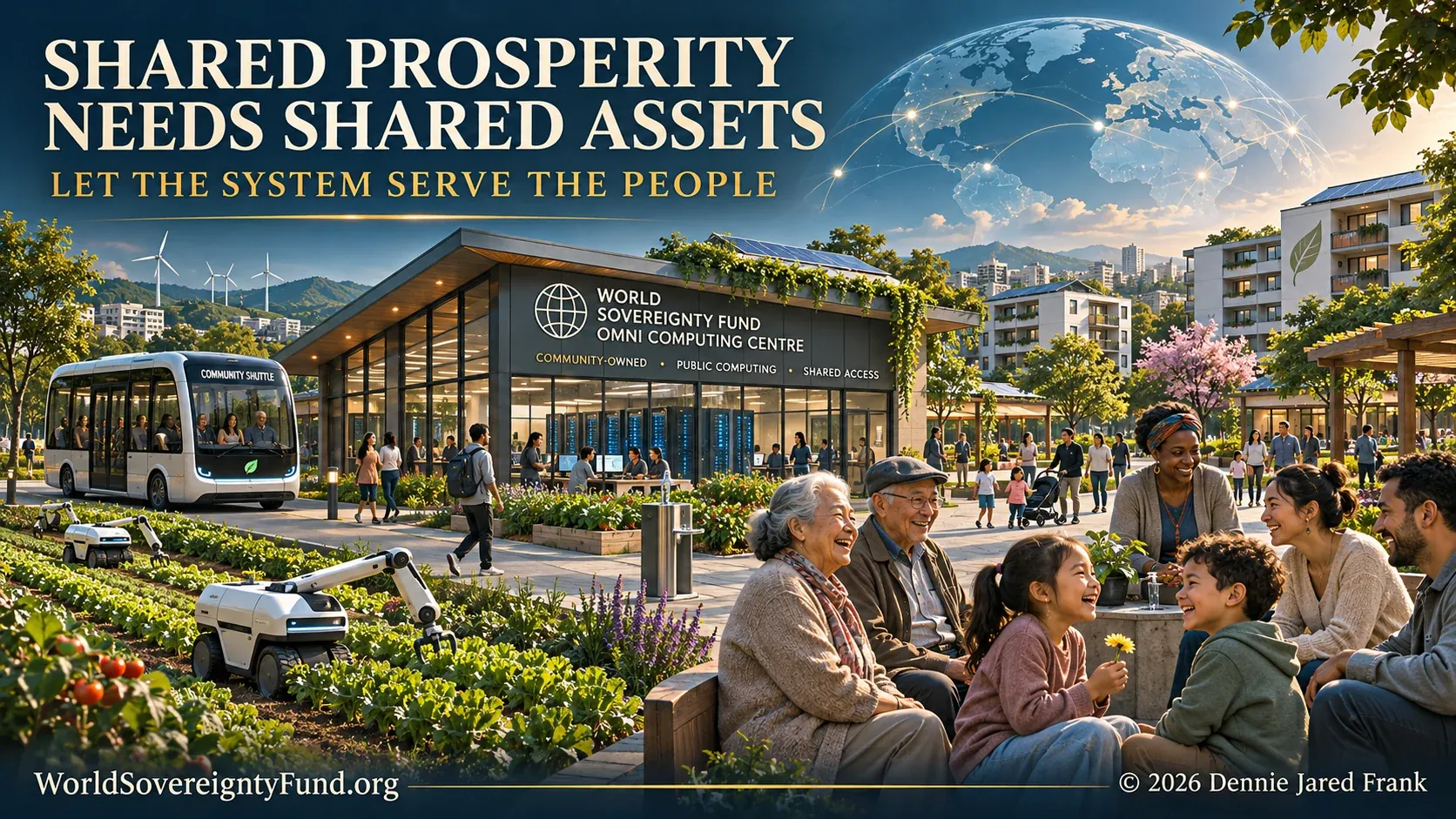
Community-owned Omni Centres would provide computing and coordination for participating automation. Human oversight, transparent contracts, and meaningful community authority would be essential.
The aim is to give the public another route to ownership and income. Concentrated power should face enforceable limits wherever it appears, including inside this proposed institution.
PEOPLE, COMMUNITIES AND A LIVING EARTH
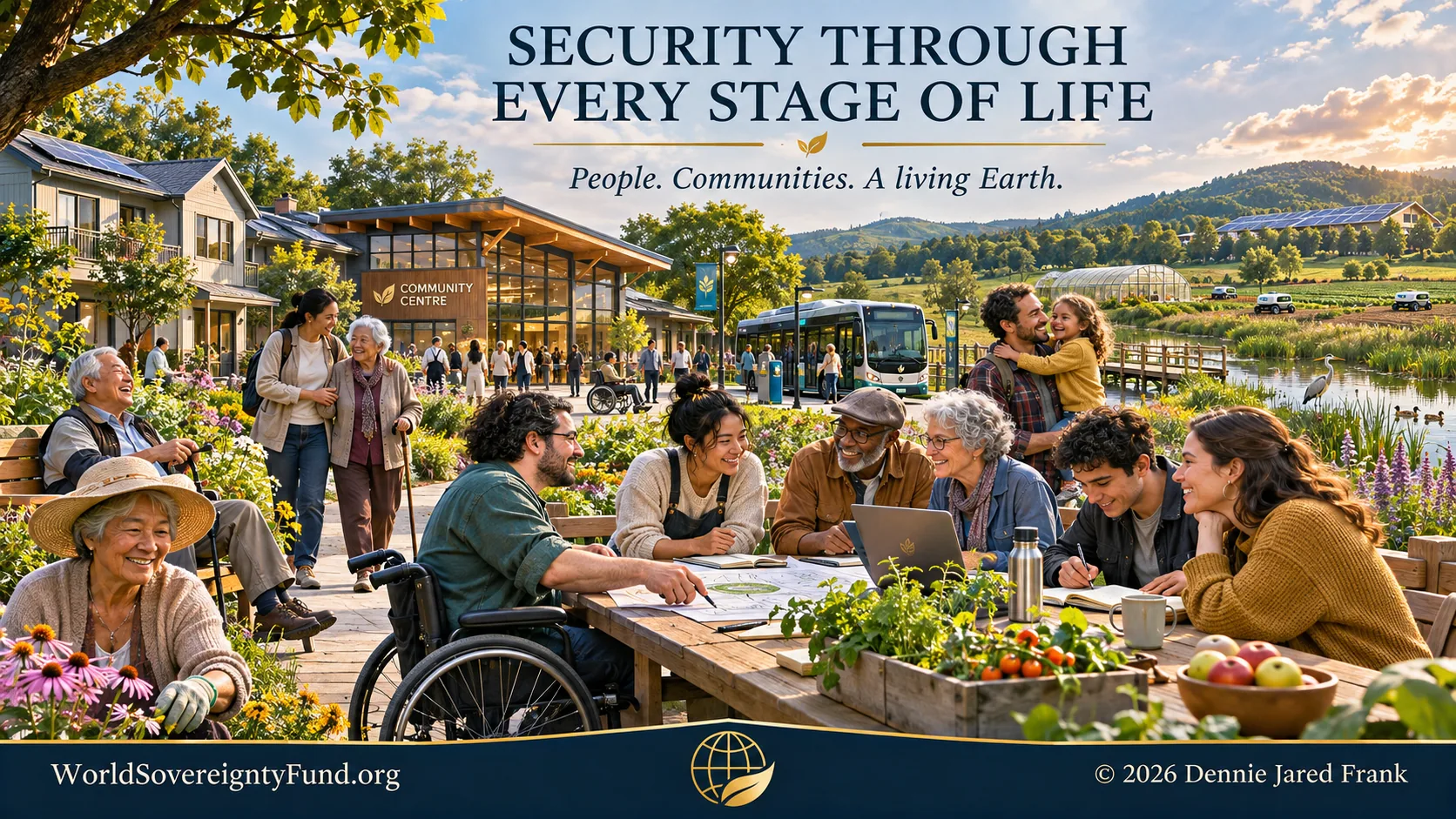
Security through every stage of life.
A community is stronger when people can grow older with dignity, live with a disability without being pushed aside, care for one another, and protect the place they call home. The World Sovereignty Fund proposes building shared wealth to help make that security possible over time.
More security in retirement
A sustainably funded Birthright payment could provide an additional income source in later life, helping with everyday expenses and giving older people more independence. It would be an added foundation alongside pensions, savings and other support, rather than a promise that those arrangements are no longer needed.
Support when paid work is difficult
Disability, chronic illness and injury do not reduce a person’s worth. The proposed personal share is intended to support eligible people as members of society, including those who cannot work. It could help with daily costs and greater choice; disability-specific care, equipment and services would still need dedicated support.
Time to care and a stronger start
Parents, unpaid caregivers and people supporting an aging relative could have more room to balance care with paid work. Young adults could gain breathing room to learn, train or build a business. A shared income source could also provide a buffer during a difficult transition.
Communities with lasting assets
Community allocations could support accessible housing, local transport, food production, water systems and community-owned enterprises. People would help decide local priorities through accountable governance. Working together would create assets that serve neighbours and future generations.
An Earth worth passing on
The ecological allocation would give environmental work a dedicated place in the model: restoring watersheds, protecting habitats, improving soil and supporting cleaner energy. Projects would need measurable benefits and public reporting. Human security depends on healthy land, water and ecosystems.
Cooperation alongside existing systems
People can come together to build this additional public-benefit structure while existing banks, businesses, pensions and public services continue operating. Participation and funding would follow lawful agreements. Implementation would need to coordinate with existing benefits so that intended support is not simply lost through offsets or replacement.
A practical model: one approved amount, three lasting purposes
Participating enterprises and other agreed funding sources build the permanent Fund. Under the proposed early policy, capital stays invested and only approved net interest is available for distribution. The model below shows how that approved amount could serve people and the Earth.
70% / PEOPLE
Income through life
Ordinary spendable money for eligible participants, including older adults and disabled people. Retirement, disability and caregiving are examples of how people could use the same personal allocation; they are not extra percentages added to it.
20% / COMMUNITIES
Shared local foundations
Community development and practical services, with decisions based on local needs, transparent budgets and public accountability.
10% / THE ENVIRONMENT
Protect and restore
Ecological stewardship that supports a healthier Earth and the resources communities depend on.
For example: $30 million in approved annual net interest would allocate $21 million to people, $6 million to community development and $3 million to ecological stewardship. Shared equally among 10,000 eligible people, the personal allocation would be $175 per person per month. The calculators below let you explore the scale required.
It will take people coming together, and it will take time. Small pilots can test what works before expansion. Meaningful worldwide support could take 50–100 years or longer to build; that is a planning horizon, not a promised delivery date. Payments depend on real assets, available interest, costs, reserves and the number of participants. The aim is a lasting additional source of security, built carefully enough to serve generations.
We already share the consequences of economic change. By choosing to build shared assets, we could also share more of its benefits: dignity in later life, support through disability, time for care, stronger communities and a healthier Earth.
THE NUMBERS MUST WORK
A promise cannot replace capital.
A large fund can still produce a modest payment when its earnings are shared among many people. Explore a simplified illustration of the proposed 70% personal allocation.
$175.00Illustrative monthly personal payment per participant
$30 million approved for annual distribution; $21 million allocated to people.
Formula: capital × annual distributable share × 70% ÷ participants ÷ 12. All amounts use the same illustrative dollar currency. The share entered is an assumed payout available after costs and reserves, not a predicted investment return. Nominal amounts exclude inflation and individual taxes. This calculation is not a benefit offer or guarantee.
WORKING TABLE 2 / FUND EARNINGS
One approved amount. Three public benefits.
This table makes the 70% / 20% / 10% proposal at the top of this page adjustable in dollars. Enter the annual interest approved for distribution and the number of eligible people. Every row updates automatically.
Of that approved amount, 70% supports personal Birthright payments, 20% supports community development, and 10% supports ecological stewardship.
Preserve the foundation. Contributions entering the Fund build its capital. Under the proposed early interest-only policy, capital stays invested; only interest approved after costs and reserves enters this table. An assumed interest rate is not a guaranteed payment.
Proposed use of approved fund interest
Purpose / share
Annual total
Monthly equivalent
People · 70%Personal Birthright benefits
$21,000,000
$1,750,000
Community · 20%Community development
$6,000,000
$500,000
Ecology · 10%Ecological stewardship
$3,000,000
$250,000
Total · 100%
$30,000,000
$2,500,000
$175.00Illustrative monthly personal payment per participant
$30,000,000 in approved interest is fully allocated. The monthly columns divide each annual total by 12.
Annual allocation = approved interest × the stated percentage. Personal monthly amount = approved interest × 70% ÷ eligible participants ÷ 12. Figures use the same illustrative dollar currency. Monthly equivalents do not specify a payment schedule.
Fixed illustration of the default example. The working table below recalculates independently when you change its inputs. All shares use the original agreed contribution; the interbank transfers are not additional allocations.
WORKING TABLE 3 / ROBOT BANKING PROPOSAL
Community first. Connected worldwide.
Community-owned Omni Centres coordinate participating automation. The separate Robot Banking System handles accounts, payments and transfers through community, country and world institutions.
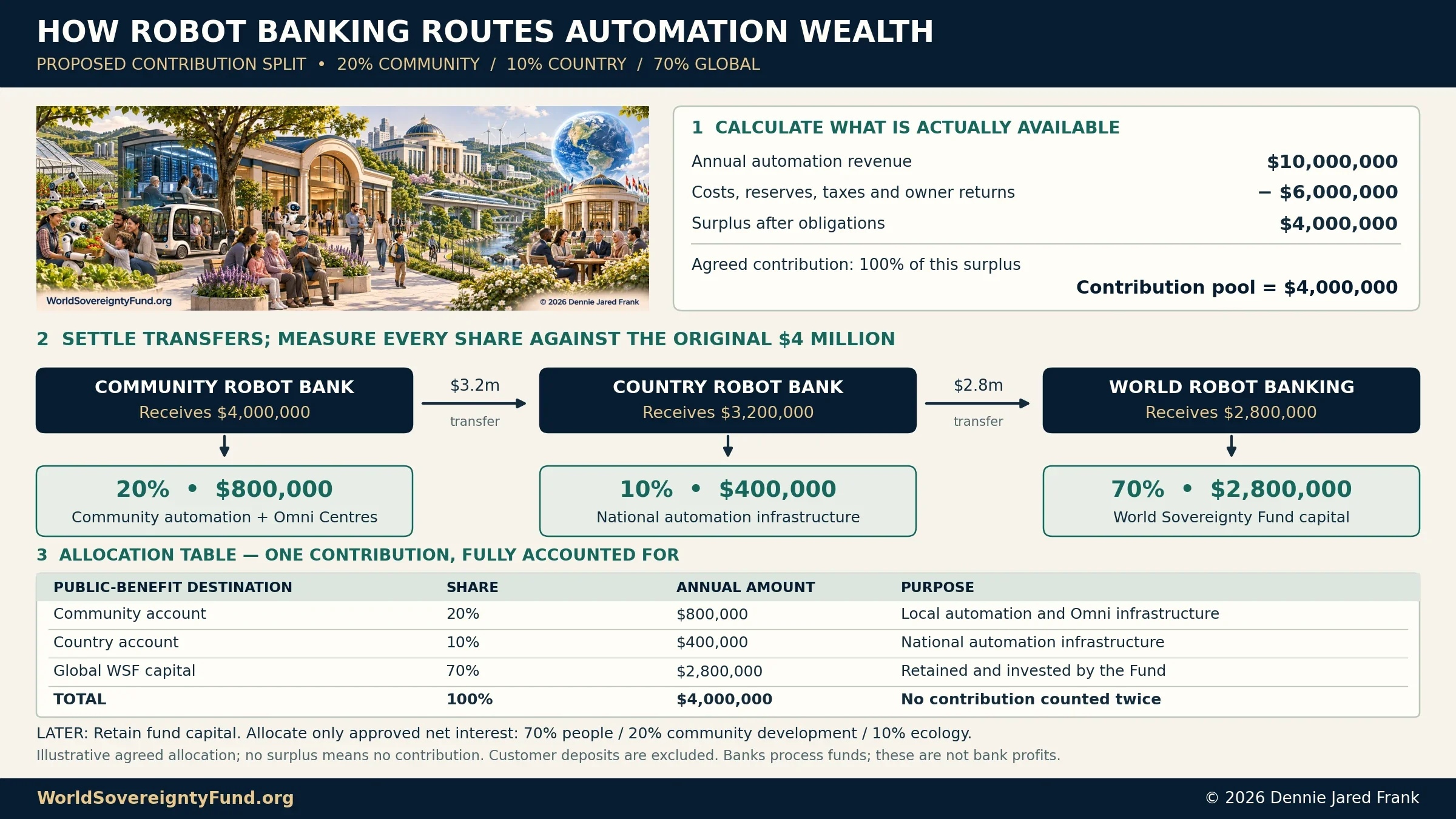
This new routing example assigns 20% of an agreed net contribution to community automation, 10% to the country, and the remaining 70% to global fund capital. Adjust the community and country shares below; the global share is the remainder needed to total 100%.
Earn revenue and cover obligations. Participating automation earns money from goods and services. Cover wages, energy, equipment, maintenance, taxes, reserves and contracted owner returns before calculating the agreed contribution.
Community Robot Bank: 20% locally. Keep the community allocation in a designated public-benefit account for local automation, Omni computing capacity and related infrastructure.
Country Robot Bank: 10% nationally. Route the country allocation to designated national automation infrastructure and coordination. The country bank also settles transfers between community banks.
World Robot Banking: the remaining 70% globally. Route the global allocation through the world settlement institution to the World Sovereignty Fund as protected capital. This proposed World Robot Banking institution is separate from the existing World Bank.
People receive a later, separate distribution. The Fund invests its capital. Only approved interest is available under the early interest-only policy; the separate 70% people / 20% community / 10% ecology table above shows how that approved amount could be used.
Two stages, different pools. This table routes new contributions. The table above allocates approved fund interest later. The community share here supports automation; the community share above comes from fund interest for development. Neither split is a deduction from a person's Birthright payment or from customer deposits. Banks process these allocations; the percentages are not bank profits.
Global share of contribution: 70% Automatically calculated as 100% − community share − country share.
$4,000,000Agreed annual contribution available to route
$4,000,000 in surplus after obligations; $0 remains with the participating enterprise after its agreed contribution.
Where the agreed contribution goes
Destination / route
Share
Annual amount
Community automationVia Community Robot Bank
20%
$800,000
Country infrastructureVia Country Robot Bank
10%
$400,000
Global WSF capitalVia World Robot Banking
70%
$2,800,000
Total contribution
100%
$4,000,000
The $2,800,000 global allocation builds fund capital. It is not an immediate personal payout.
Contribution = max(revenue − obligations, 0) × agreed contribution percentage. Each destination receives its share of that one contribution, not a fresh percentage of the money left after the previous transfer. No surplus means no contribution. Deposits, loans and repayment of principal are not automation earnings.
This is an adjustable proposal for designated public-benefit allocations. The funding agreement would determine the contribution rate and permitted uses; the illustration does not set a tax or authorize a bank to take private funds. Amounts are rounded for display.
TRUST MUST BE EARNED
The safeguards are part of the idea.
Public wealth requires public accountability: independently audited accounts, transparent decisions, conflict disclosures, divided authority, participant rights, and protected channels for reporting wrongdoing.
AI-assisted monitoring could help identify irregularities and preserve evidence for an independent oversight body. Allegations must be investigated, with human judgment, due process, and an appeal route. No person or algorithm should hold unchecked authority over shared wealth.
Dishonesty and misuse must carry enforceable consequences under applicable law. No system is corruption-proof. Its credibility depends on detecting failures, correcting them, and protecting people who expose them.
A foundation for generations, with evidence at every stage.
FIRST / ESTABLISH
Test the structure
Independent feasibility work, a legal charter, governance arrangements, financial modelling, and a practical community pilot.
THEN / VERIFY
Prove the economics
Measure costs, contributions, risks, and public benefit. Publish results. Correct weaknesses before expanding.
OVER TIME / GROW
Scale what works
Reinvest, build partnerships, and expand only as real resources and accountable institutions support it.
The proposal is candid about scale. Meaningful worldwide benefits could require 50–100 years or longer. That is a planning horizon, not a forecast. Smaller local benefits might come sooner if pilots succeed. A dividend depends on available distributions; a guaranteed basic-income floor would need a separate, dependable financing mechanism.
LET THE SYSTEM SERVE THE PEOPLE
Public benefit needs more than good intentions. It needs an institution.
Support independent assessment, practical development, and a public voice in how this framework takes shape.
Your signature supports consideration of the proposal. It does not enrol you for payments.
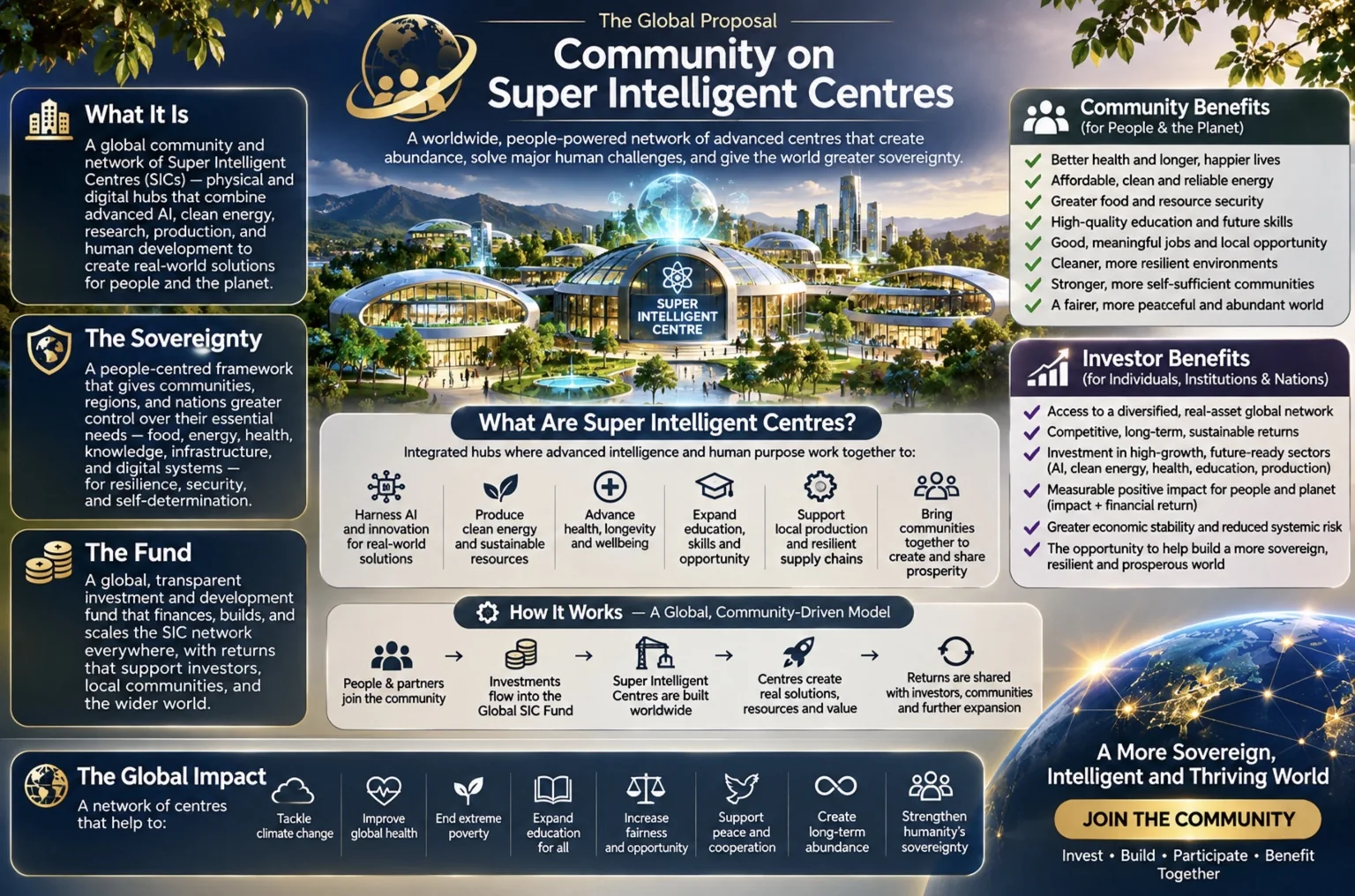
How the community vision connects
The Fund is proposed as a long-term institutional framework. Community centres are one potential way to build shared productive assets; existing banks and private enterprise would continue.