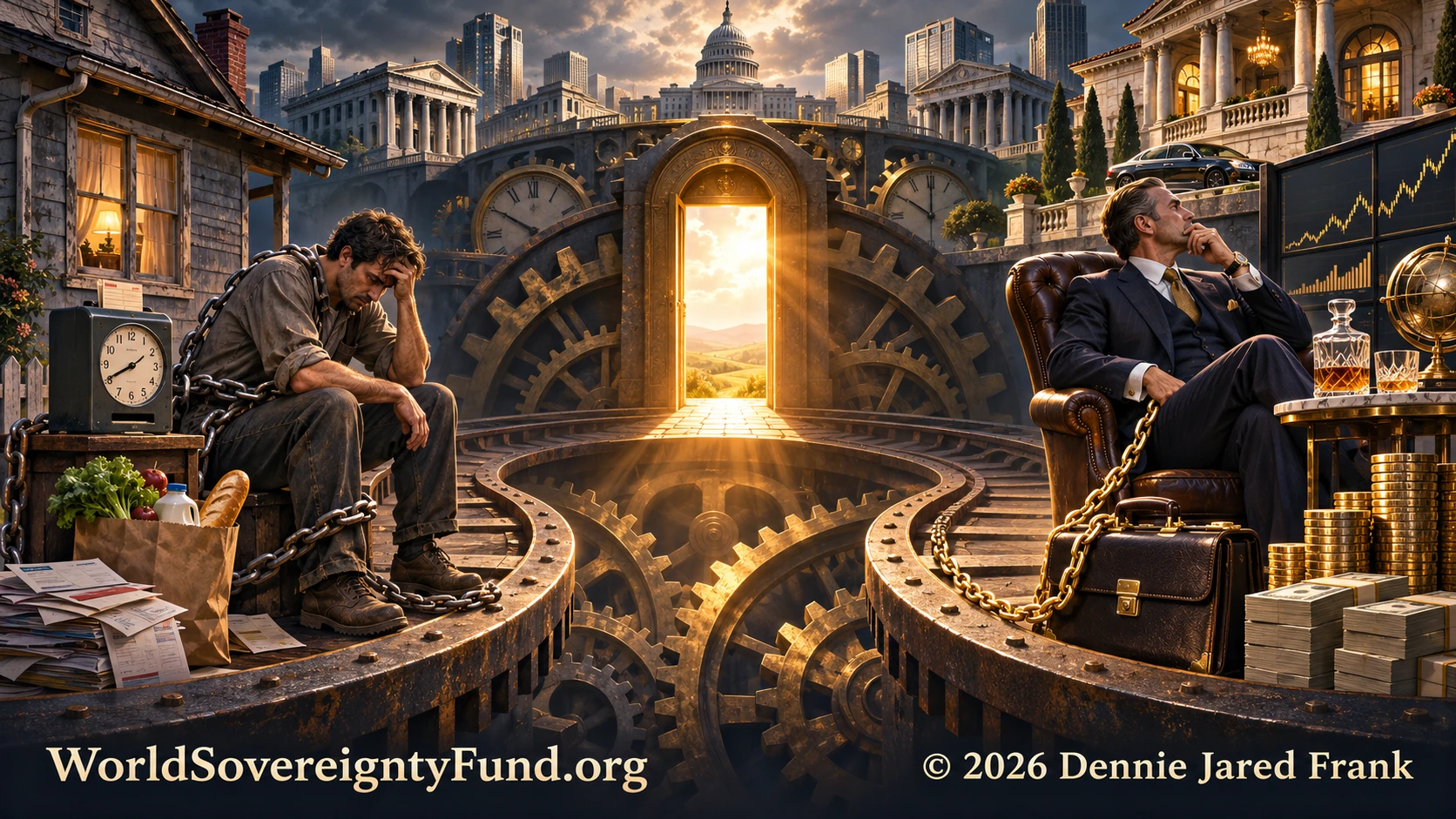
The Architecture of DominationAn argument for meaningful freedom
Rich or poor · A question for everyone
If you choose not to participate, is there any meaningful exit?
Will you survive?
If you stop earning and paying, what happens to your home, food and security? If you already have wealth, how much of your life is spent protecting it, preserving your position and staying ahead?
The pressures and the power are unequal. But the question reaches across them: can you step outside the system and remain secure—or does fear of losing what you need, or what you have accumulated, keep pulling you back?
The question automation forces us to face
If machines can do most of the work, what will you live on?
When a machine replaces your job, what replaces your paycheque?
If human labour is no longer needed to produce most of what we use, how will people pay for food, shelter and a future? Who will buy what the machines produce? And who will receive the wealth—the wider public, or only the owners of the machines?
Will we use automation to give people more time, security and freedom—or keep making survival depend on work that may no longer exist?
If machines can create the wealth, why must your right to survive still depend on having a job?
Structural forced labour
When survival has a price, how free is the choice?
You can leave a job. But can you leave the need to sell your time to keep a roof over your head? Dennie Jared Frank examines the difference between having rights and having the means to exercise them.
By Dennie Jared Frank · Author, The Architecture of Domination
The premise
Freedom should mean more than choosing who gets your working hours.
My argument is that a society can remove the legal ownership of people while still arranging survival around their dependence on work they cannot realistically refuse.
You may be free to change employers, negotiate a contract or start a business. Yet those choices depend on your health, savings, family responsibilities, housing and access to opportunity. When every available route to food and shelter requires accepting someone else’s terms, the freedom to refuse can become very narrow.
I use structural forced labour to describe that pressure: an economic structure in which people must keep selling their time to remain secure, while ownership and accumulated wealth can give others a much greater ability to step back. Calling this a form of disguised slavery is the moral argument I am making about dependence, power and the price of survival.
Work itself is not the enemy. People create, build, teach, care and contribute because those things matter. The question is whether we are contributing through meaningful choice or complying because the alternative is losing the essentials of life.
What the terms mean
In international law, forced labour involves involuntary work imposed under a threat of penalty. Slavery concerns the exercise of powers associated with ownership over a person. Economic dependence alone does not establish either legal condition. This essay uses “structural forced labour” as a broader social critique; it does not mean that every wage earner is legally enslaved.
The pressure can come from the structure around us.
No single person has to control every decision for dependence to shape a life. Several ordinary pressures can reinforce one another, leaving a person with formal choices and very little room to act.
I / SURVIVAL
The essentials cannot wait.
Food, shelter, heat and transport keep costing money even when a person is ill, exhausted or out of work. If a household has little reserve, the next bill can become the deciding factor in whether someone tolerates a harmful situation.
II / DEBT
Tomorrow’s time is already committed.
Borrowing can make a home, education or an emergency expense manageable. Repayments also commit future income. When those commitments consume the available margin, changing direction becomes harder.
III / OWNERSHIP
Access is different from control.
A wage can pay for access to housing and other necessities without giving a worker ownership of the assets generating income. Someone with substantial productive assets may have options that someone relying entirely on wages does not.
IV / BARGAINING POWER
A contract is not a measure of equal power.
An agreement can be formally voluntary while the parties have very different alternatives. Savings, public services, labour protections and collective bargaining can change what a person is realistically able to refuse.
V / INVISIBLE CONTRIBUTIONS
Necessary work can go unrewarded.
Raising children, caring for relatives and supporting a community create real value. When security depends mainly on paid employment, people doing essential unpaid care may have less money, independence and recognition.
VI / AUTOMATION
Who owns the machines matters.
If machines can produce more with fewer human working hours, ownership determines who receives the resulting earnings. Greater output alone does not guarantee that displaced workers or the wider community will share the benefit.
The central question
“If saying no puts your survival at risk, we should ask how much freedom the choice really contains.”
Dennie Jared Frank · The argument behind structural forced labour
Real choice
The test is whether you can refuse exploitation and remain secure.
Freedom becomes more practical when a person has somewhere safe to live, time to recover and a credible alternative to accepting harmful conditions.
This is not a claim that all employment is abusive or that all employers act alike. Fair employment, supportive businesses and enforceable rights can expand people’s choices. The structural question is what happens when those protections fail: does someone have a way out, or does survival push them back into the same conditions?
Rights and the conditions that make them usable
A formal choice
What makes the choice practical?
Leave a job
Enough financial breathing room to find safer work without immediately losing the essentials.
Refuse unsafe conditions
Enforceable protections, a voice at work and protection against retaliation.
Care for a loved one
Time, support and income security during periods of unpaid care.
Benefit from progress
Access to services and a meaningful share of the value produced by new technology.
Where is the exit if you must always keep paying?
For many people, there is no practical exit from the need to keep money coming in. Rent, mortgage payments, food, utilities, taxes, registration renewals and debt repayments keep arriving. Changing jobs does not remove those obligations. The pressure follows you.
A paid-off home does not mean a paid-off life. You can legally own your home and still need money to remain secure in it. Property taxes continue; unresolved arrears can eventually lead to a tax-recovery sale through the required legal process. Maintenance and essential services still cost money. Owning a vehicle does not remove the registration and insurance requirements for using it on public roads. Legal ownership is real, but it does not make you independent of continuing costs and conditions.
When there is little money left after the bills, a missed paycheque or accumulating overdue payments can threaten the security you have spent years building. You keep earning to protect your home, keep the lights on and avoid being pushed towards homelessness. The fear of losing what you need can make stopping feel impossible.
Wealth gives people much greater freedom and bargaining power. Yet the desire to protect a fortune, preserve status and remain on top can also keep people invested in the same system. Some participate because they cannot afford to lose their security; others keep competing because they do not want to lose their advantage.
This is my argument about structural dependence: the pressure to survive and the incentive to stay on top can both keep people serving the system. If keeping what you have requires you to keep paying indefinitely, where is the meaningful freedom to step outside it?
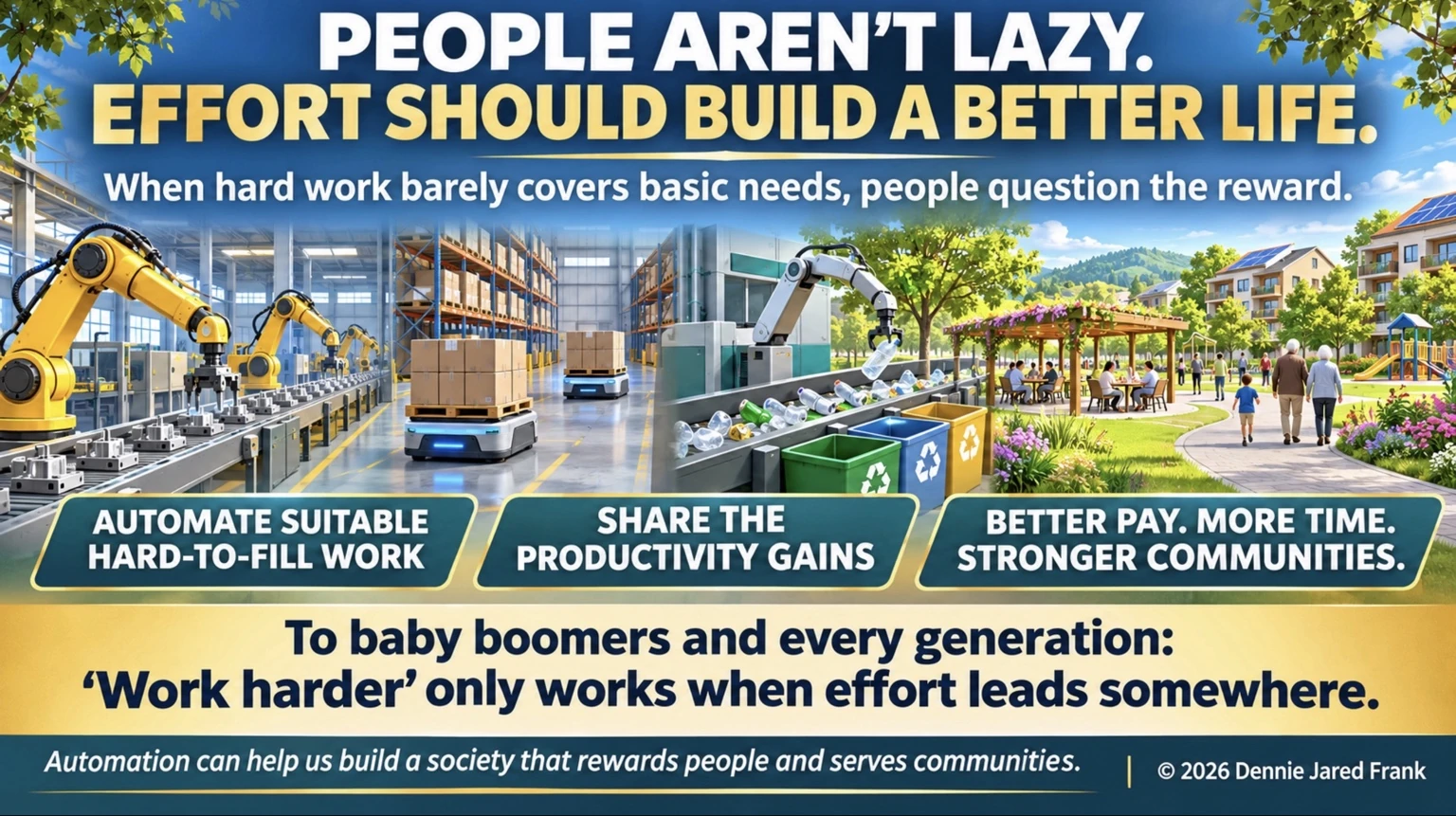
Let automation reduce dependence on compulsory survival work.
Machines could take on more dangerous, repetitive and unwanted work. Whether that creates greater freedom or greater insecurity depends partly on how their ownership and earnings are organised.
My proposed World Sovereignty Fund and Birthright System would build a permanent public wealth fund over time. A separate Robot Bank and community-owned Omni-Superintelligence Centres would form part of the proposed automation framework. Participating enterprises and centres would cover their costs before remitting agreed net earnings to the Fund.
The long-term aim is for part of sustainable distributable earnings to support ordinary people through a Birthright income, alongside community development and environmental protection. Each person’s Birthright Coin would represent a non-transferable entitlement, rather than an asset that can be sold, traded or pledged away.
Security
A stronger foundation beneath a person’s ability to change work, recover or care for someone.
Shared prosperity
A route for some automation earnings to benefit people beyond existing owners of capital.
Public accountability
Transparent governance and community oversight of assets intended to serve the public.
This is a proposal requiring independent assessment, financing, governance and practical trials. It would operate alongside existing banking and private enterprise. An initial focus on building capital and spending only sustainable investment income would mean gradual growth; meaningful worldwide scale could take 50–100 years or longer.
The wider work
Question the architecture. Imagine a different foundation.
The Architecture of Domination is my seven-book exploration of power, dependence and the institutions that shape human life. These works develop the broader argument behind this site.
A signature expresses support for further consideration. It does not create a payment entitlement or guarantee adoption, funding or a payment date.
LET THE SYSTEM SERVE THE PEOPLE
Definitions & further reading
An argument open to examination.
This site presents Dennie Jared Frank’s social and economic argument. The sources below explain the international definitions used to distinguish that argument from legal slavery and forced labour.